
About the Authors:
✍️ Scott Walldren is the Head of SEO at Acadia
✍️ Matt Rosenfeld is the President of CRUSH, an Acadia Company
Summary: AI engines like ChatGPT, Claude, Google’s AI Overviews, or Rufus are reshaping how customers discover brands. This article explores how marketers can stay visible and relevant in the era of AI search by focusing on clarity, authority, and structured optimization.
When you ask ChatGPT for the best running shoes or Amazon's Rufus for a new pizza oven, you're not searching, you're deciding. Brands working with the best ecommerce marketing agency partners are already optimizing for this AI-driven discovery shift.
Google’s AI Overviews now appear above traditional results. Tools like ChatGPT, Claude, and Perplexity bypass search engines entirely. And on Amazon, Rufus curates personalized product recommendations in seconds.
This marks the biggest shift in digital discovery since the invention of the search engine. Visibility is no longer about keywords or clicks, but about relevance, trust, and becoming the brand the algorithm believes in.
This article explores how AI is redefining discovery across platforms, what it means for marketers trying to reach today’s audiences, and how to adapt using practical frameworks and forward-looking metrics.
From Search Engines to Answer Engines
For years, marketers optimized for clicks, keywords, and backlinks. But the traditional search journey (query, click, conversion) is fading. The rise of AI-powered results is collapsing that journey into a single, frictionless interaction.
- 1 in 8 Google searches now surfaces an AI-generated answer right at the top of the page.
- 1 in 10 users never even touches a search engine. They go straight to conversational AI tools like ChatGPT, Claude, or Perplexity.
- And among Gen Z consumers, 3 out of 4 use these tools daily.
That shift is seismic. It means the next generation of consumers isn’t discovering brands through search results, but through synthesized AI responses.

The Long-Tail Revolution
Search behavior itself is evolving. There’s been a 7x increase in queries that are eight words or longer, as people begin to “talk” to Google the same way they do to AI assistants.
Fifteen percent of these queries are completely new, phrased in personal, conversational language that algorithms have never seen before.
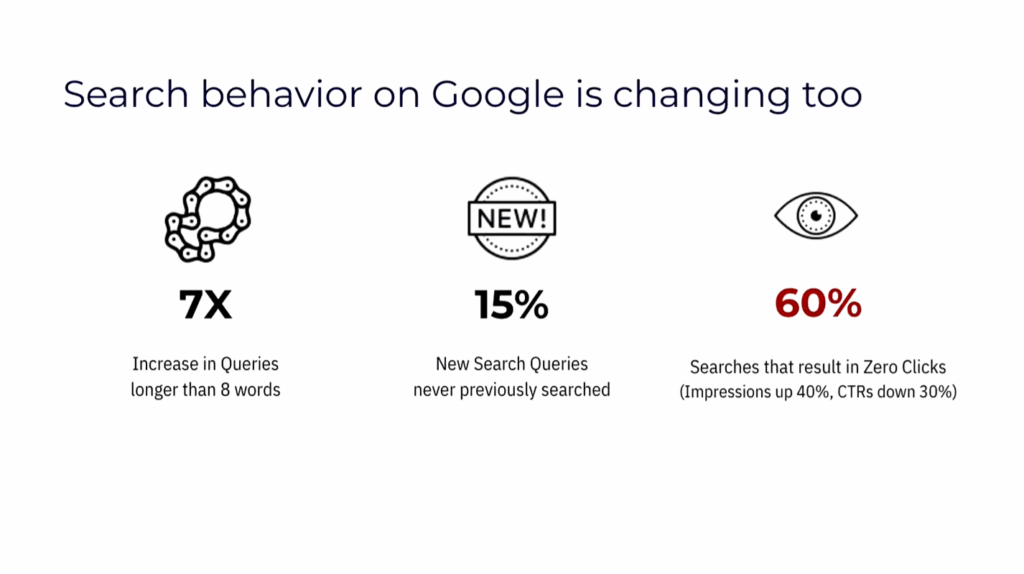
And yet, 60% of Google searches now end without a click.
For informational queries, such as “Who is…?”, “How do I…?”, and “What does this mean?”, the figure jumps to 75%. Even half of commercially focused searches, such as product comparisons, never lead to a click.
Why? Google, ChatGPT, and other AI tools are delivering complete, conversational answers directly in the search experience.
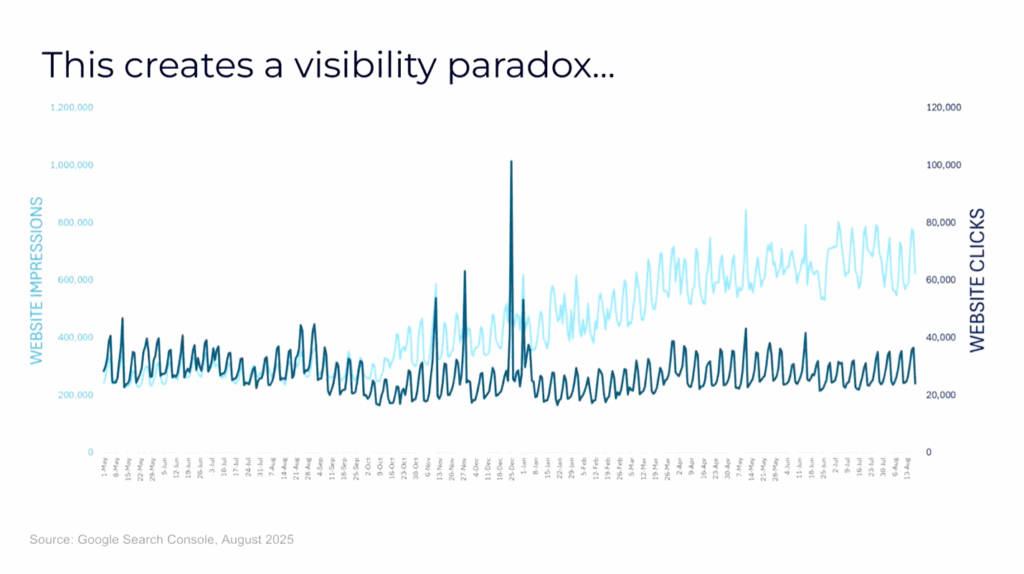
The implication for brands is profound: visibility no longer guarantees traffic.
Impressions are climbing, but clicks are flattening or falling. Brands are being mentioned or cited in AI summaries rather than clicked on.
The goal now isn’t just to rank, but to be referenced.
Example:
Picture this: You are going to pick up your brother from the airport, but since he has an early flight, you decide to stay at a hotel near the airport and meet him in the morning. Your dog is coming along, so you turn to Google and type: “pet-friendly hotels near the Atlanta airport.”
Within seconds, an answer appears: an AI-generated recommendation highlighting a well-known hotel chain as the best nearby option for travelers with pets. The same brand shows up again when you ask ChatGPT and Claude.
What’s remarkable is how that conclusion was reached. The AI systems pieced together data from multiple sources: the hotel’s optimized pet policy page, its Google Business Profile, a Wikipedia listing, and even Reddit threads where travelers shared their own pet-friendly experiences.
No single page won the click. Instead, a web of credibility formed around the brand, structured content, user validation, and consistent messaging all signaling to the algorithms: “This is the right choice.”
It’s a perfect example of how AI discovery now mirrors human intuition. The machine didn’t just find a hotel; it understood the traveler’s need and confidently made the match.

Reddit: The Unexpected Power Player
In this new ecosystem, Reddit has emerged as an unlikely authority. Its user-generated discussions, real experiences, and authentic opinions are becoming the backbone of AI responses.
Both Google and OpenAI recognized this early, striking multimillion-dollar deals to license Reddit’s content. The reason is simple: Reddit provides “lived experience” data that validates AI-generated recommendations.
When someone searches for “the best breakfast pizza” or “pet-friendly hotels near the airport,” Reddit posts often supply the supporting evidence AI engines use to justify their answers.
For brands, that means community engagement and third-party validation matter more than ever.
Conversations happening in “rooms you’re not in” are shaping the recommendations that consumers see.
Inside Amazon’s AI Transformation
Now that we discussed how people search, let’s talk about how they shop.
At the center of this transformation is Rufus, Amazon’s AI shopping assistant, quietly changing the way customers make purchase decisions.
Rufus isn’t just another chatbot; it’s a guide that helps shoppers move from curiosity to confidence in a few simple exchanges.
Ask about the best pizza ovens, and Rufus doesn’t just list products; it synthesizes reviews, product specs, and common customer questions to recommend the right option for your needs.

As shoppers explore deeper, Rufus anticipates what they’ll ask next, drawing on millions of data points from across Amazon’s ecosystem.
It’s a glimpse into the future of e-commerce: a world where AI curates information in real time, helping customers feel certain they’re buying the right product without ever scrolling through endless pages of reviews.
But here’s the catch: most brands aren’t ready for this shift.
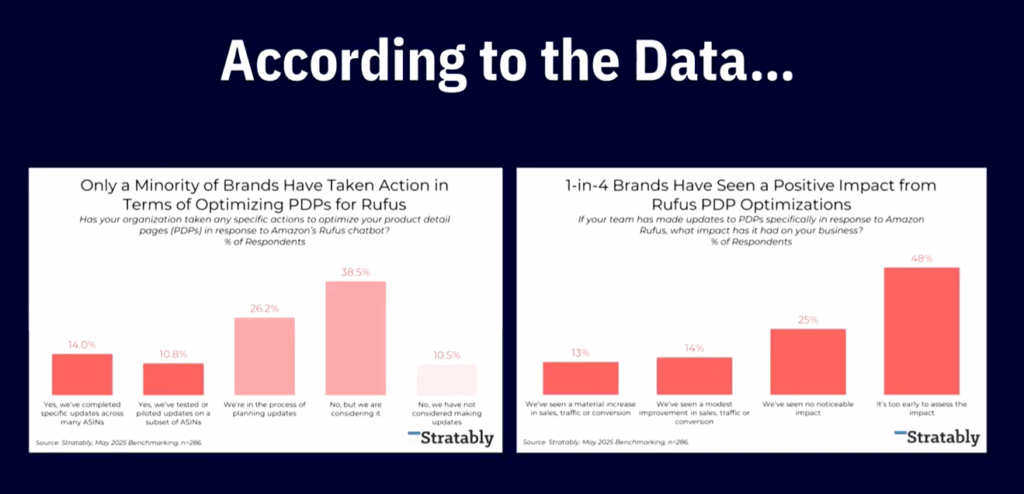
Only a small fraction have even begun optimizing their product detail pages (PDPs) for Rufus, and among those that have, few have seen clear performance gains. Part of the challenge is that no one has fully defined what “AI optimization” looks like on Amazon yet.
What’s clear, however, is Amazon’s motivation. At its core, Amazon’s business model and its AI evolution both revolve around one mission: getting the right product to the right customer at the right moment.
Think of Amazon as a matchmaker: an intelligent intermediary that learns from millions of signals to connect intent with solution. Every query, every review, every purchase, and every return teaches the system more about what works for whom.
In other words, Amazon’s incentives and the brand’s incentives are further aligned.
Both benefit when the customer finds the right product quickly and confidently, and doesn’t return it a week later. The better the match, the stronger the relationship between brand, platform, and consumer.
But alignment alone isn’t enough. To know whether AI-driven optimization is working, brands need to measure it. Which raises a crucial question: what metrics actually signal success in this new era?
The New Metrics That Matter
For decades, marketers have lived and died by a familiar set of numbers: rankings, traffic, and share of voice. Those metrics made perfect sense in a world built on clicks and search bars.
But in an age of conversational AI, zero-click results, and algorithmic recommendations, those yardsticks no longer tell the full story.

Here are the metrics you should keep an eye on:
1. Click-Through Rate (CTR)
CTR tells us whether our content is appearing in front of the right audience and whether that audience finds it compelling enough to engage.
Especially in environments like Amazon, where brands pay for sponsored placements, CTR is a measure of targeting accuracy. It answers the question:
“Are we showing up in the right context, and are we giving consumers enough confidence to click?”
A strong CTR signals that product titles, images, and descriptions are effectively aligned with user intent, an essential first step in any AI-shaped discovery journey.
2. Conversion Rate (CVR)
Once a consumer clicks, conversion rate becomes the critical test of trust. Whether the visit is organic or paid, every click represents a moment of belief. The AI system has already suggested that your product might be the best fit.
The job now is to validate that confidence quickly. Clear copy, authentic reviews, and compelling visuals should make the customer feel certain that they’ve found what they’re looking for.
A strong conversion rate not only drives immediate sales but also reinforces the algorithm’s understanding that your listing satisfies real customer needs, boosting future visibility.
3. Targeted Impression Share
In the past, marketers focused on overall share of search or share of voice, measuring how often they appeared in broad categories.
But AI has made discovery more precise and personal. Now, it’s about showing up in the moments that matter most. Targeted impression share measures visibility, click-through rate, and conversion rate for a carefully chosen set of high-intent queries: the searches most relevant to your audience and product.
Tracking these metrics over time shows whether updates to titles, bullet points, pricing, or promotional strategies are actually moving the needle with your target consumer
Relevancy: The New North Star
Relevancy determines everything:
- Whether your brand appears in an AI-generated response
- Whether consumers trust that recommendation
- And whether that interaction translates into a sale or a lasting impression
Relevancy now defines marketing success, and it’s built on three pillars:
- Content: Every product detail page, article, or listing should clearly communicate what your brand offers and why it matters. The language should mirror how your customers search and speak, using natural phrasing and direct answers.
- Reputation: AI models increasingly draw from public signals: customer reviews, Reddit discussions, Wikipedia entries, and other third-party validations. Positive sentiment and consistent messaging across these channels help reinforce your authority and trustworthiness.
- Technology: Behind every relevant brand is clean technical work. Schema markup, structured data, and proper page connections help AI systems understand not just what you sell, but how your content relates to other trusted sources on the web.
When these elements work together, brands can earn consistent organic visibility inside AI-generated results, fueling a “flywheel” effect that compounds over time.
The 3Cs Framework for the AI Discovery Era
So where do you go from here?
Acadia’s 3Cs Framework provides a roadmap for thriving in the era of AI-driven discovery:
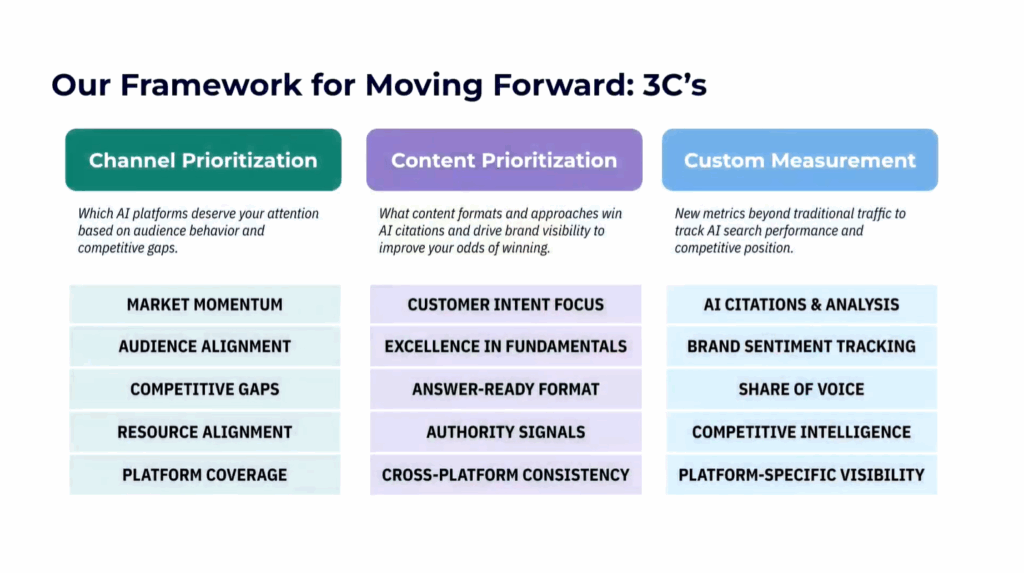
1. Channel Prioritization: Meet Customers Where They Discover
The first step is understanding where your customers are discovering information.
Gen Z, for instance, is spending more time on platforms like ChatGPT, Perplexity, and other AI tools than on traditional search engines. But beyond that, every industry has its own discovery landscape.
If your audience is researching on Pinterest, YouTube, Instagram, or Reddit, that’s where the algorithms are learning, too. Publicly available platforms are feeding the data that trains large language models.
Owning your organic presence on these channels, by maintaining up-to-date profiles, engaging in discussions, or activating employee networks to participate, ensures your brand’s voice is part of the content ecosystem AI is referencing.
The goal isn’t to be everywhere, but to choose one or two high-impact channels to test, learn, and grow consistently.
2. Content Prioritization: Speak the Customer’s Language
Next comes content prioritization, which is all about clarity and relevance.
The most effective AI-era content is what we call “chunky content”: straightforward, conversational, and focused on getting to the answer quickly.
This means writing in the language your customers actually use, not industry jargon. When your website, articles, and listings mirror the phrasing and questions consumers type or speak into AI tools, you increase your chances of being surfaced in AI-generated results.
3. Custom Measurement: Redefining Success
Finally, custom measurement ensures you’re tracking what truly matters. Focus on metrics that reflect engagement and performance in context: conversion rate, stickiness, and brand sentiment.
Pay attention to how your brand is represented within large language models and AI-generated content, and monitor how users are talking about you across digital platforms.
By shifting your measurement strategy toward these modern indicators, you’ll gain a more accurate picture of how your brand performs in today’s fragmented discovery landscape.
The Path Forward
The age of search is giving way to the age of synthesis. Consumers no longer navigate lists of links; they trust machines to find, filter, and recommend on their behalf.
For marketers, that’s both a challenge and an invitation.
To win in this new landscape, you must adapt quickly, prioritize authenticity and relevance, and understand that every AI answer is a new kind of search result, one that can make or break the next customer connection.
The discovery ecosystem is being rewritten. Will your brand be part of the conversation?
Frequently Asked Questions
What is AI Engine Optimization (AEO), and how is it different from SEO?
AEO is the evolution of SEO for the AI era. SEO helps you rank on search engines. AEO helps you get referenced by AI-generated answers. It’s about clarity, trust, and context: ensuring AI tools like ChatGPT or Perplexity can confidently include your brand in their recommendations.
Should our brand be on Reddit and other discussion platforms?
Yes, if it’s authentic. AI models like ChatGPT and Google’s AI Overviews frequently draw from Reddit discussions as “lived experience” data. Participating honestly in community conversations (through employees, ambassadors, or partners) helps strengthen your brand’s reputation and ensures accurate mentions in AI-generated content.
How can we optimize our Amazon listings for Rufus and AI-driven shopping?
Treat each product detail page (PDP) as a structured data source for Rufus.
- Use clear, conversational titles and bullet points.
- Add FAQs and schema markup.
- Optimize reviews and Q&A sections for completeness. Rufus relies on structured, high-quality data to make confident recommendations. The more organized your content, the higher your chances of being surfaced.
- Learn more by reading this article.
What’s the first step toward becoming “AI-discovery ready”?
Start with an audit:
- Ask ChatGPT or Perplexity questions your customers would ask (“What’s the best X for Y?”) and see if your brand appears.
- Review how your structured data, brand profiles, and public mentions align.
- Then, use Acadia’s 3Cs Framework (Channel, Content, Custom Measurement) to prioritize, optimize, and track your visibility in the AI ecosystem.
Related Resources
Read more from this author: