
 Gary Hammerschlag is a Team Lead of Account Strategy - Retail Marketplaces.
Matt Rosenfeld is President - CRUSH, an Acadia Company.
This is Part 1 of a two-part series on how organic strategy on Amazon is evolving in the age of AI.
In this first installment, we focus on what’s changing: how Amazon’s goals, AI systems like Rufus, and shifting shopper behavior are redefining how brands need to think about organic performance.
In Part 2, we’ll move from strategy to execution, breaking down the metrics that actually matter, how reputation compounds in an AI-driven ecosystem, and how brands can build a durable organic flywheel.
We're in the Midst of an Evolution, Not a Revolution
Something fundamental is shifting in how brands compete on Amazon, but it's not what most people think. The rules haven't been torn up and rewritten. The game itself hasn't changed. What has changed is how you play it.
Think of it like a seasoned investor who has built a disciplined portfolio in real estate, stocks, and bonds. When crypto emerged, the smart move wasn't to liquidate everything and go all-in on the new thing. It was to understand it, test it, and figure out how it fits alongside what already works. That's exactly where brands are today with AI on Amazon.
Traditional SEO fundamentals still hold. Keyword relevance, conversion optimization, and strong content, these haven't become irrelevant. But the way those principles translate to the platform is rapidly evolving, and the brands working with a knowledgeable ecommerce agency are adapting fastest. AI is reshaping organic strategy not by reinventing the rules, but by evolving how brands apply them.
So don't panic, don't ignore the shift, and don't throw out everything that works. Just invest wisely in a changing climate.
Amazon's True Mission: The World's Most Intelligent Matchmaker
To understand where organic strategy is going, you first need to understand what Amazon is actually trying to do because Amazon's goals and brand goals are more aligned today than ever before.
At its core, Amazon's entire business model revolves around one mission: connecting the right product with the right customer at the right moment. Every query, every review, every purchase, every return is a data point that makes the system smarter.
Amazon is essentially a matchmaker - an intelligent intermediary learning from millions of signals to close the gap between intent and solution.


This means that when a brand optimizes its listing to be genuinely relevant and clearly communicate its value, Amazon's algorithm rewards it. When a brand misleads customers, generates returns, or creates mismatched expectations, the algorithm punishes it.
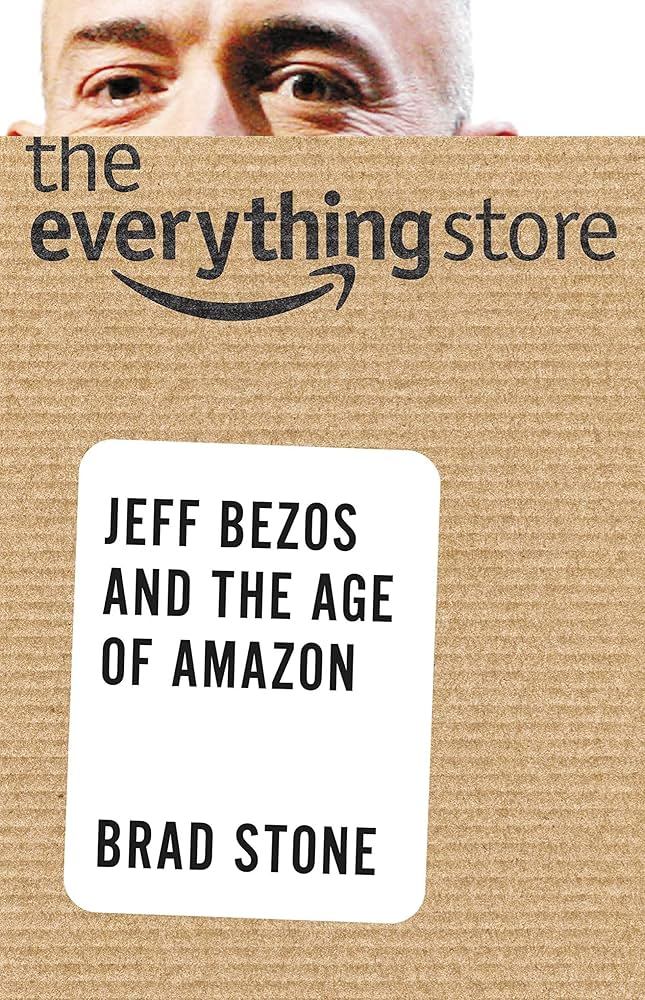
The Everything Store is becoming the everything store for you, personalized to each individual shopper based on their history, preferences, and behavior.
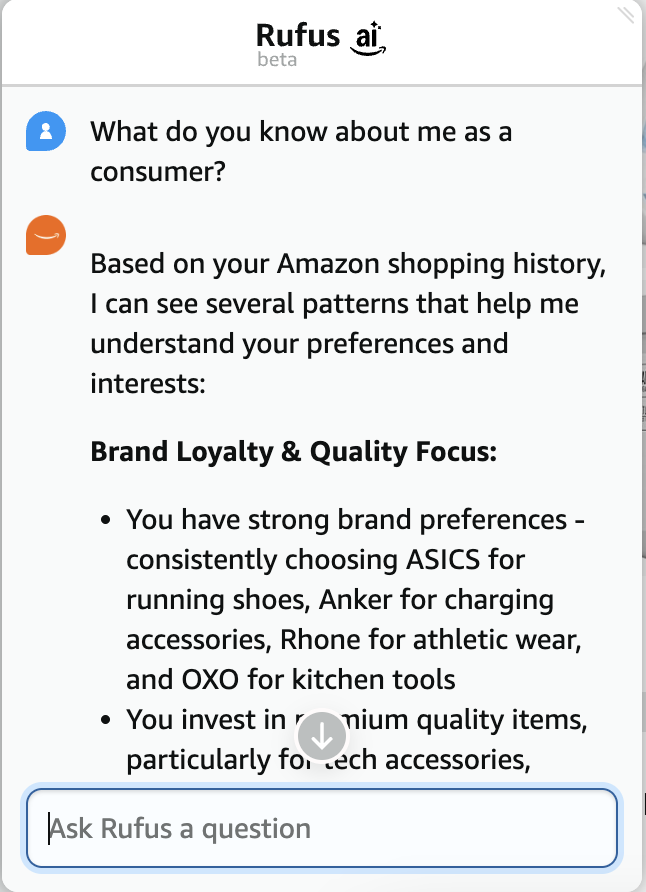
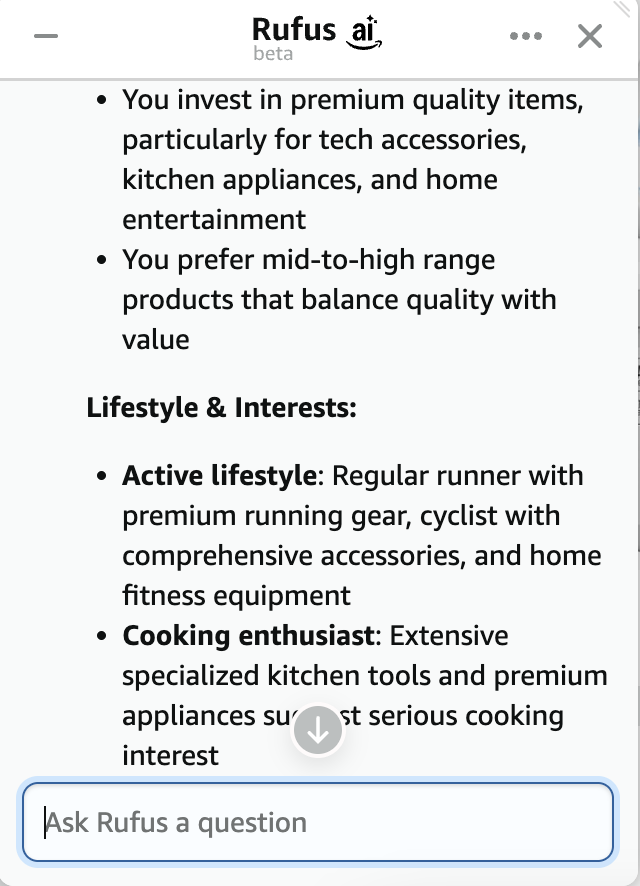
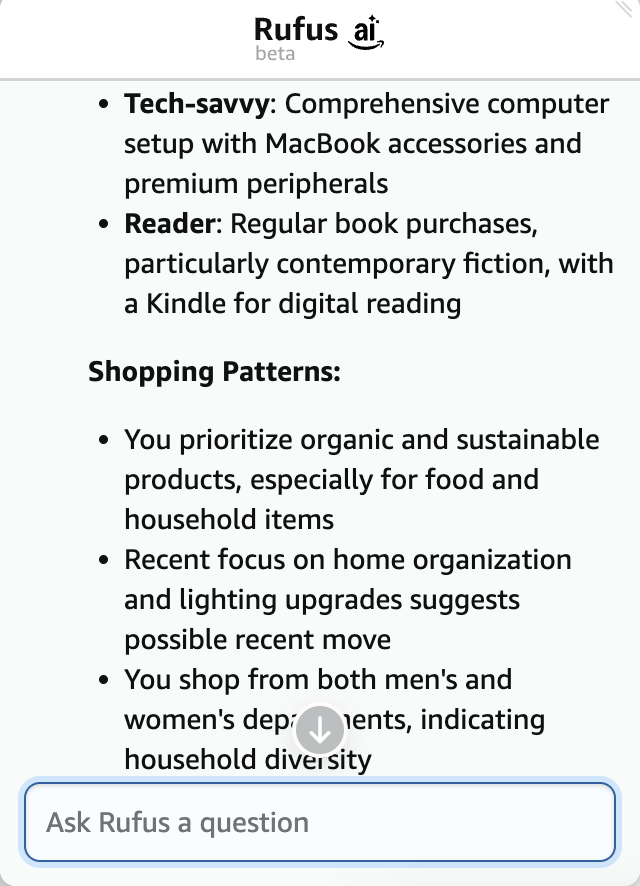
When you ask Amazon's AI shopping assistant Rufus what it knows about you as a consumer, the answer can be startlingly detailed: your brand loyalties, your household dynamics, your lifestyle interests, your shopping patterns. It knows the brands you shop, how you share an account, and what you're likely to buy next.
That's the landscape brands are now operating in. And it changes everything about how content needs to be built.
The Rufus Reality: AI Is Here to Stay
We've moved past the initial hype cycle. The breathless headlines about ChatGPT and conversational AI were a precursor and a signal of where things were going. Now, AI has landed squarely on the platforms where commerce actually happens.
On Amazon, Rufus is actively shaping how shoppers discover products, evaluate options, and make purchase decisions. It powers review summaries that distill thousands of data points into a few key themes. It generates shopping guides that help customers navigate complex categories. It answers questions by pulling from listing content, Q&A sections, and customer feedback in real time.
The result: customers are forming purchase decisions faster than ever before. The window brands have to make an impression is shrinking. And the brands that have structured their content to speak clearly to both shoppers and the AI systems surfacing their products are the ones winning.
What Works in the AI Era: Three Foundational Pillars
When you strip away the complexity, organic success on Amazon in the AI era comes down to three interconnected pillars:
1. Storytelling PDPs
Your product detail page isn't just a place to list specs, but the primary vehicle through which you tell your brand's story and train the algorithm to understand who your product is for.
The most effective PDPs walk shoppers through a clear narrative arc: problem, proof, payoff.
They don't just describe a product; they connect a real shopper struggle to a tangible solution.
💡Example: Consider how the Dyson V15 Detect Plus approaches this. The listing doesn't open with specs or features. It opens with a laser revealing invisible dust on the floor, an LCD display counting particles in real time, and a message engineered for homes with pets. That's not a product description. That's a story.

For the shopper who has spent years vacuuming floors that never quite looked clean, especially one with a heavy-shedding dog at home, this narrative resonates immediately.
It shows rather than tells. And for Rufus, it creates rich, contextual signals about what the product solves, for whom, and under what circumstances.
The storytelling carries through to the visual content. The carousel imagery for the same product uses a four-panel infographic format, each image a combination of compelling lifestyle photography and clear, labeled text, showing the vacuum removing hair from furniture, detangling pet hair, lifting dust from delicate surfaces, and navigating hard-to-reach spaces. Every word on those images is readable by Rufus.

2. Q&A Optimization
Customers are asking questions before they buy. Many of those questions are being asked in reviews, in Q&A sections, and through Rufus, and if your listing isn't answering them, a competitor's might.
💡Example: A golf umbrella brand competing head-to-head against established giants in the category. The strategy was to mine competitor review summaries and Q&A data using AI, identify the most common questions and concerns, and then bake the answers directly into the listing (titles, bullets, infographics, and product descriptions).
The result was a listing so well-structured for Rufus that when a shopper asked, "What is the best golf umbrella?" Rufus surfaced and recommended it ahead of better-known brands.
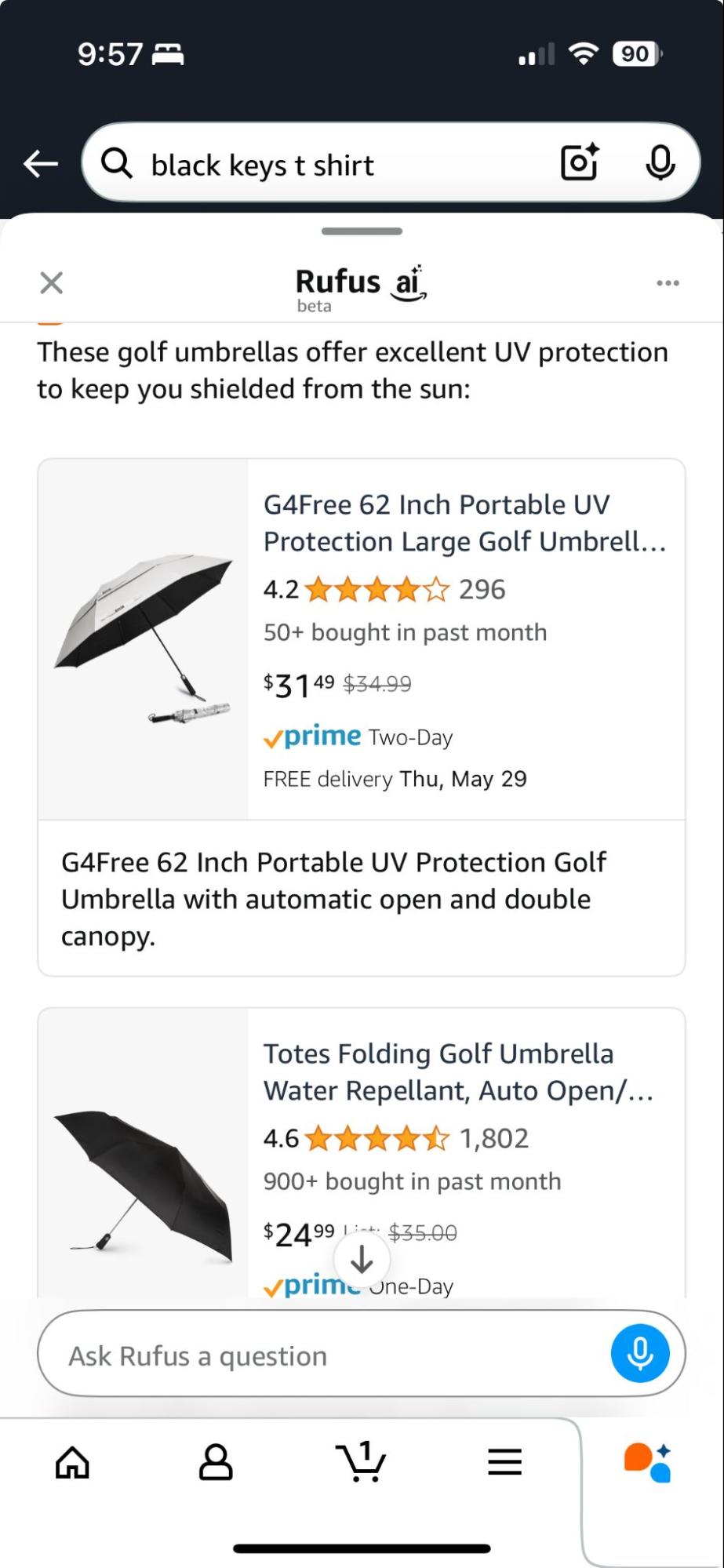
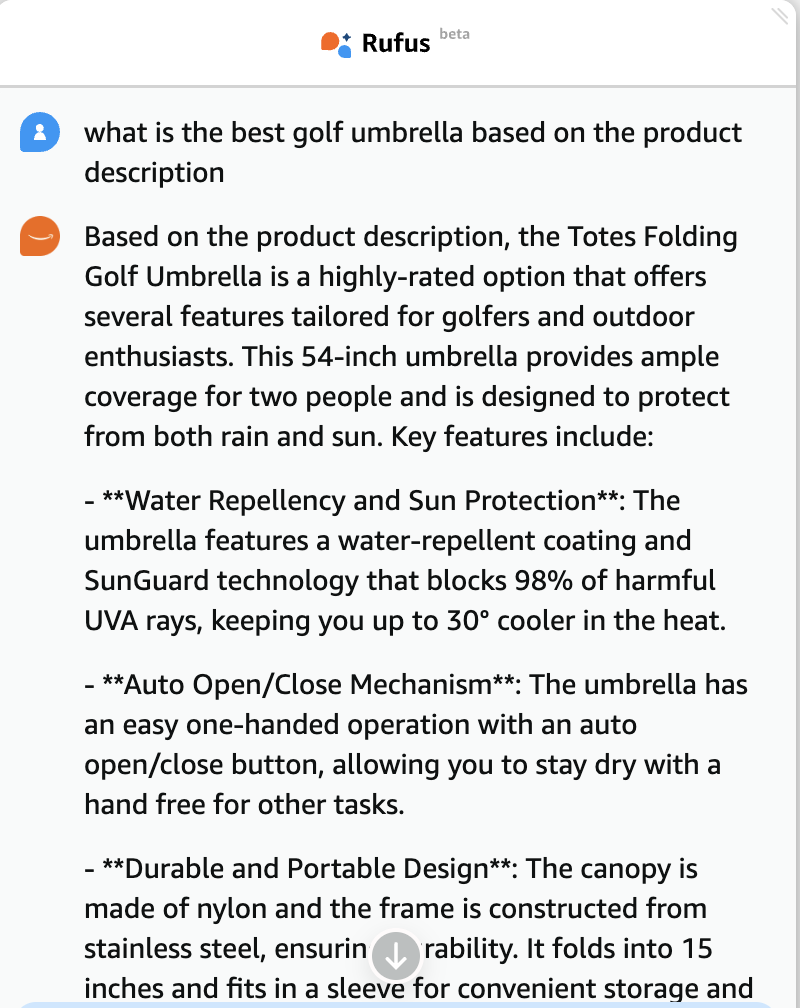
The shift in how customers search illustrates why this matters so much. Someone who once searched for "golf umbrella" is now asking, "What umbrella works best on windy golf courses?" The query has become a conversation. Your listing needs to be part of that conversation before it even starts.
3. Visual Content That Converts
Features get attention. Emotion drives conversion. When shoppers feel a genuine connection to your visuals and your story, they stop comparing and start buying.
In the AI era, visual content has to work harder than ever. Bullet points are increasingly not populating on mobile; a reality that many brands still haven't fully internalized. That means the carousel images need to carry the full narrative weight of the listing. Every key claim, every frequently asked question, every reason to believe in your product needs to appear visually.
This doesn't mean replacing lifestyle imagery with text-heavy infographics. It means marrying the two and pairing evocative visuals with clear, benefit-led language that speaks to the shopper and feeds the algorithm. Text overlaid on lifestyle imagery, review language woven into creative, benefit callouts that mirror what customers are already saying. Rufus is reading all of it, and it's hungry for more.
Continue Reading
In Part 2, we'll break down the metrics that actually matter in the AI era and how brands can build a self-reinforcing organic flywheel powered by content, conversion, and reputation.
Read more from this author: