✍️ Scott Walldren is the Head of SEO at Acadia.
Anthropic is rolling out invisible watermarks in text generated by supported Claude models. The easy reaction is to treat that as an SEO threat. It is not.
The watermark can indicate that Claude was involved in a passage. It cannot prove Claude originated the ideas, identify the user, or establish a Google policy violation. Google does not prohibit appropriate AI use, and there is no published evidence that Search uses Claude's watermark as a ranking signal.
The real exposure sits in content governance: contracts, disclosure commitments, authorship claims, and the quality of what a brand publishes. Keep using generative AI when it improves the work. Tighten provenance and editorial controls instead.
What Anthropic Announced
The change is Anthropic's way of complying with the EU AI Act's transparency requirements, which became applicable on August 2, 2026. The company chose to apply the marking worldwide rather than build a Europe-only version, and published its technical explanation on August 14.
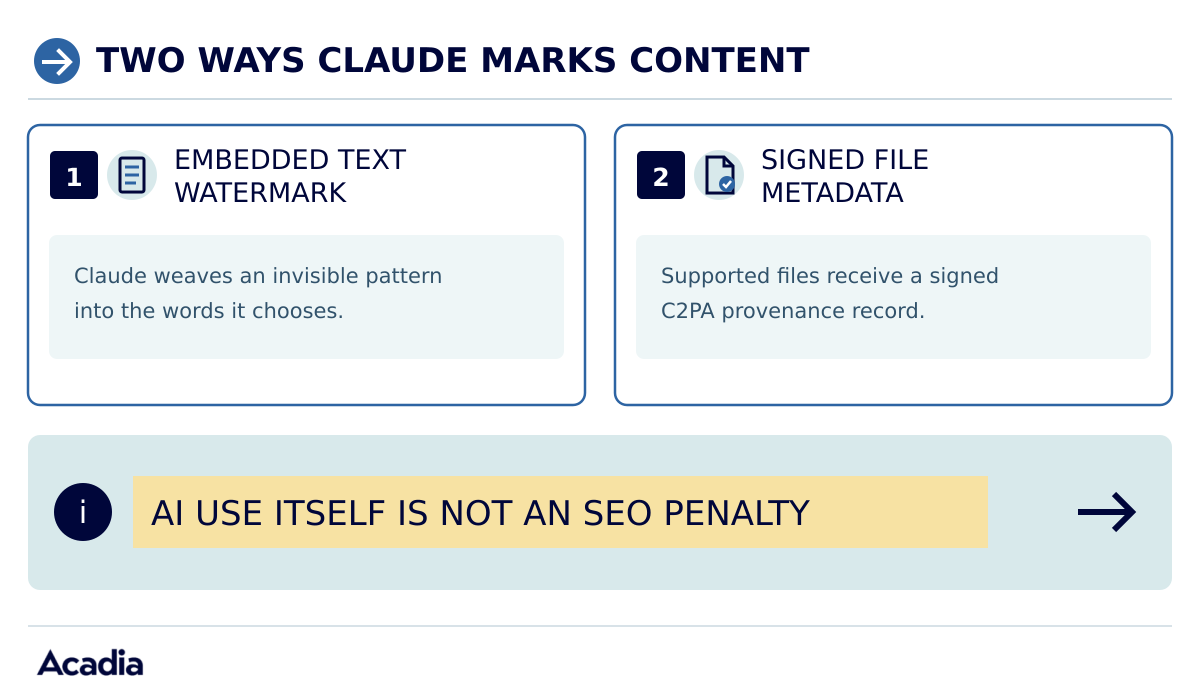
The rollout is not instant across every model. Supported Claude models launched on or after August 2 include machine-readable marking from launch, and Anthropic says it is working to add marking to older models over the coming months. Coverage spans Claude's consumer products, the API, Claude Code, Cowork, Tag, and supported models accessed through AWS, Google Cloud, and Microsoft Foundry. Generated image files carry signed C2PA metadata. Text carries a statistical watermark.
Anthropic also plans to release a detection tool, but has not yet published its accuracy rates, thresholds, access terms, or a date. You cannot build a compliance process around a detector that does not exist yet, and you should not assume every Claude response you have ever generated is already marked today.
How the Watermark Works, in Plain English
Claude writes one small piece at a time, and at many points several next words would work equally well.
Take a sentence like "The campaign drove strong results and increased customer..." Claude might reasonably land on "interest," "engagement," or "demand." Normally, a random process settles that choice. With watermarking, those choices are subtly nudged by a secret key, and across a long enough passage they form a statistical pattern. A detector holding the key can then ask whether the sequence of word choices matches the pattern Claude tends to produce.
Nothing visible is added. There are no hidden characters, no invisible HTML, no odd fonts, no account information, and no extra words. The pattern lives in the words themselves, which is why copying and pasting usually preserves it and why heavy rewriting can weaken or remove it. The method is based on Google DeepMind's SynthID Text approach, the same one used in Gemini.
What a Detected Watermark Means
This is the part most of the panic skips. Anthropic is explicit that a detected watermark points to likely Claude involvement in the text. It says nothing about who authored the underlying ideas, and it cannot tell the difference between "Claude wrote this" and "Claude edited or translated this." A human can originate the research and ideas, run the draft through Claude for a rewrite, and end up with watermarked output.
That is a meaningful difference from conventional AI detectors, which guess based on writing style. Anthropic's detector looks for a pattern tied to its key. Neither one is proof of who wrote something, and neither should be treated that way.
The Google Position
Here is the executive statement that holds up: Google does not prohibit or automatically penalize content because generative AI was used. Google says its systems focus on the quality and usefulness of content rather than how it was produced, and it has stated plainly that useful, original AI-assisted content can rank.
But "Google doesn't penalize AI content" is too broad, and repeating it that way gets teams in trouble. Google's guidance also warns that producing many pages primarily to manipulate rankings can violate its scaled content abuse policy, and generating pages at scale with AI and no added value is one of its explicit examples. The distinction is simple. Using AI has never been the offense. What gets punished is churning out low-value pages at scale to game rankings.
A watermark does not change that math in either direction. It does not turn acceptable content into spam, and removing it does not rescue content that was already thin. As of now, neither Google nor Anthropic has published anything saying Google Search uses the watermark for ranking, demotion, indexing, or manual actions.
The watermark also has nothing to do with Google's hidden-text policy. It exists in the normal, visible wording rather than concealed HTML or CSS.
The Watermark Is Not the Biggest AI-Content Risk
The watermark does introduce genuine exposure. Most of it lands in governance, well short of the SERP.
Start with contracts and misattribution. Because the mark signals involvement rather than authorship, work a human originated can carry a watermark after a Claude rewrite or translation. That becomes a contractual and reputational problem the moment a partner, employer, or publisher treats "AI involvement" as "AI authorship." If a statement of work bans generative AI, requires disclosure, or promises entirely human-written deliverables, a detectable watermark makes existing noncompliance easier to spot. The contract risk already existed. The watermark just makes it easier to catch.
Then there is detection reliability. This is a probability system, and probability systems get things wrong. False negatives are plausible in short passages, factual writing, code, human drafts that Claude only lightly edited, heavily paraphrased output, and content from older models. No business, hiring, or publishing decision should rest on a watermark result alone. And because rewriting weakens the signal, the honest user leaves the mark in place while a motivated bad actor strips it. That enforcement imbalance is worth being clear-eyed about.
Strip the watermark away, and the real risks of generative content are exactly what they were last month. Models still confabulate, producing confident but wrong claims, invented statistics, and citations that do not exist. Published under an expert byline, that erodes trust faster than any provenance signal.
The biggest risk is homogenization. Even when every sentence is unique, the page can add nothing meaningfully different from what already ranks. Brands that describe themselves generically get summarized generically. Specific attributes, concrete trade-offs, and named claims produce more confident descriptions and earn more citations. Clarity is the leverage, and a watermark does nothing to change that.
What We Advise
No bans, no defensive rewrites, no watermark-removal workflow. There is no evidence of an SEO emergency, and a removal process mostly creates the appearance of concealment.
- Map Claude usage. Inventory where Claude shows up across your accounts, API workflows, vendors, and contractors.
- Review contracts and disclosures. Audit agreements with partners for AI prohibitions, disclosure requirements, and human-authorship promises.
- Record content provenance. For substantive content, keep track of who wrote it, what the model's role was, and who reviewed it.
- Require human approval and original contribution. Put a named person in charge of accuracy and final publication, and make original input a publication requirement, whether that is proprietary data, expert commentary, or firsthand testing.
- Test the detector before creating policy. When Anthropic's tool ships, run it on long and short content, edited drafts, and translations before you write a single rule around it.
One caveat for ecommerce teams: Google Merchant Center has its own requirements for labeling AI-generated product titles, descriptions, and images. That lives in feed compliance, and teams keep confusing it with an organic search penalty. They are separate problems.
The watermark does not create a new SEO penalty. It makes existing weaknesses in governance, disclosure, and editorial control easier to expose. Fix those systems, and the watermark becomes what it actually is: a provenance signal, not a crisis.
If you want a read on where your content supply chain actually carries risk, and where the real leverage is, reach out to our team.
Sources
- Anthropic, "How Claude marks AI-generated content": support.claude.com
- Anthropic, "Claude text watermarking" (technical explanation): anthropic.com
- Google Search Central, "Google Search's guidance about AI-generated content": developers.google.com
- Google Search Central, "Google Search's guidance on generative AI content": developers.google.com
- Google Search Central, "Spam policies for Google web search": developers.google.com
Read more from this author: