
✍️ Alan Carroll is the Head of Paid Media at Acadia.
What Did Google Announce?
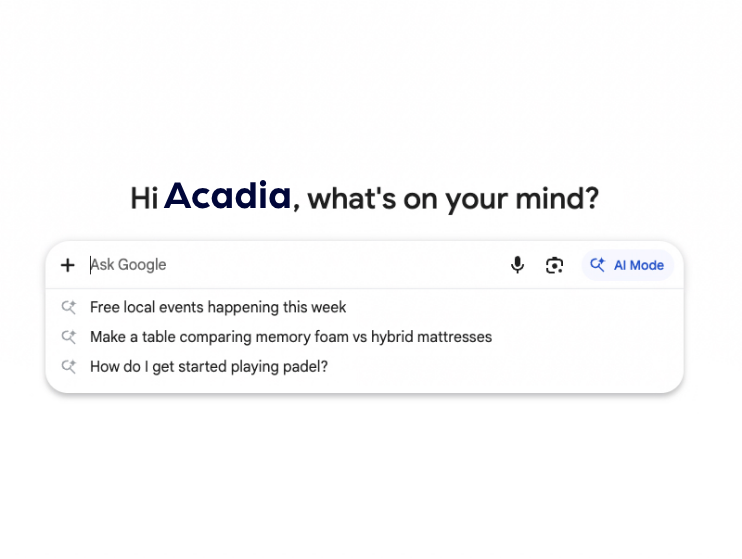
If you tuned into Google I/O yesterday, you saw the tech giant pull back the curtain on the biggest design overhaul to its search engine in a quarter-century. They are officially rolling out what they call the "Intelligent Search Box." For 25 years, we’ve all been trained to use that iconic, narrow little text bar to type in short, fragmented keyword phrases. That era is over.
The new search bar dynamically stretches and expands to handle long, conversational thoughts. More importantly, it's now completely multimodal. Your customers can now drag and drop files, upload PDFs, videos, images, or even drop entire Chrome tabs directly into the search bar to ask a question. Under the hood, Google has seamlessly merged AI Overviews and AI Mode into one single, unified experience powered by their new Gemini 3.5 Flash model. They also introduced 24/7 background "information agents" and a "Generative UI" system that builds custom layouts and data tables on the fly based on what the user is looking for.
Why Did They Make This Change?
To put it simply, Google is responding to a massive shift in how your customers are already behaving online. AI Mode has quietly surged to over a billion monthly users, and AI Overviews are hitting 2.5 billion. The old search bar was actually a bit of a bottleneck, by forcing users to truncate their natural thoughts into awkward keyword strings.
By upgrading to this smart interface, Google is attempting to remove the friction between traditional search and generative AI. They are tearing down the wall between scrolling through a list of blue links and having a conversation with an assistant. By integrating everything into one continuous workflow, Google’s goal is to keep users deeply engaged inside their ecosystem for complex, multi-step research journeys.
What Will It Mean for Brands?
Let’s talk about what this means for your campaigns right now. Because Google is actively training your audience to search using hyper-specific, multi-layered prompts and uploaded media, the traditional monopoly of exact-match keyword bidding is rapidly shifting toward deep, context-based matching. We aren't talking about abstract, future possibilities here, this is the immediate reality of how ads are being served.
In the immediate future, your ads will need to live and perform directly within an ongoing, back-and-forth conversational AI flow, rather than just sitting at the top of a static results page. Furthermore, with background information agents running searches on behalf of users and Generative UI assembling custom dashboards, the traditional path of "search query to immediate website click" is evolving.
Google’s ad auction algorithms are no longer just looking at an isolated keyword; they are analyzing the context of the entire multi-step conversation. For your brand to win premium visibility in this new setup, our optimization strategies must focus heavily on semantic depth. Your digital assets, structural data, and product feeds need to be robust enough for Google’s Gemini engine to instantly recognize your brand as the exact, highly contextual solution within these complex digital interactions.
From a measurement perspective, increasing AI integration into the consumer journey is why Marketing Mix Modeling has never mattered more. When the user journey becomes a fluid, multi-step conversation rather than a clean sequence of trackable clicks, last-click attribution doesn't just underperform... it actively misleads you. When you consider the ad ecosystem walls erected over the years, with each platform protecting its own view of the journey, attribution models as a whole face significant challenges. You lose visibility into which media exposures actually built the brand recognition that made your product the answer Gemini surfaced. MMMs help cut through that noise. It measures media's true contribution to business outcomes at the aggregate level, independent of whether a click was logged or a cookie survived. In a world where Google's own infrastructure is obscuring the path between exposure and conversion, MMM isn't a nice-to-have analytics upgrade. It's the only way to know what's actually working.
And here's where we're headed next... keyword targeting as we know it is on borrowed time. Google has been quietly degrading exact match for years and marketers have long expected a full deprecation. This is the next logical step. When the search bar accepts a three-minute video and a PDF and a typed thought all at once, the idea of bidding on a discrete keyword string starts to look like a relic. Google's AI doesn't need your keyword list to understand intent anymore. It already has a decent idea. Practically, this means the lever we've historically used to control ad visibility is disappearing. Audience strategy and messaging strategy will grow in importance to fill that void. Who are you actually trying to reach, where do they spend their time, what do they already believe,, does your creative speak to them specifically enough that Google's model picks you as the relevant answer, and does that creative actually perform in a way that reinforces the models pick? Those aren't media questions. They're brand questions. Advertisers who deeply understand their customers, create contextually relevant creative that earns attention, and build the pipelines to act on both in-platform will be set up for success in the fast-approaching future of AI-influenced marketing.
Read more from this author: