✍️ Scott Walldren is the Head of SEO at Acadia.
Google recently published official documentation naming the technical architecture behind AI Overviews and AI Mode. Separately, an independent analysis aggregated 54 experiments, patents, and case studies to score the signals most correlated with AI citations across ChatGPT, Gemini, and Perplexity.
Google tells you what matters in principle. The research tells you what to change in practice.
What Google Confirmed About AI Optimization
The disclosure isn't buried. Google named two mechanisms directly.
RAG (Retrieval-Augmented Generation) means AI responses are grounded in Google's core Search index. The model retrieves ranked pages to generate its answer. Search performance and AI visibility are the same pipeline.
Query fan-out means that when someone searches, the model simultaneously runs related sub-queries to build a more complete answer. A search for "how to fix a lawn full of weeds" spawns concurrent queries like "best herbicides for lawns" and "how to prevent weeds in lawn." The content that ranks across that cluster has more surface area for citation than the content that ranks for the original query alone.
Those two disclosures close a lot of speculation. You don't need a parallel AI strategy. Rank, and you're eligible.
Google also published a mythbusting section that SEOs should print out and keep near their keyboards. For Google Search specifically:
- llms.txt files don't influence AI visibility. Google says they aren't treated in any special way. Independent research scores them a 2.0 out of 10, the lowest signal in a 23-factor analysis.
- "Chunking" content for AI parsing isn't necessary. Google's systems understand multi-topic pages.
- Rewriting content for AI-specific phrasing doesn't work. AI systems understand synonyms and general meaning.
- Manufacturing third-party mentions gets treated the same way paid links do.
- Structured data isn't a special AI citation lever, though keeping it as part of standard SEO practice still makes sense.
Google describes these not as ineffective but as inconsistent with how the systems actually work. If a vendor is pitching any of them specifically for AI Overviews, this document is the rebuttal.
What 54 AI Ranking Studies Show About AI Visibility
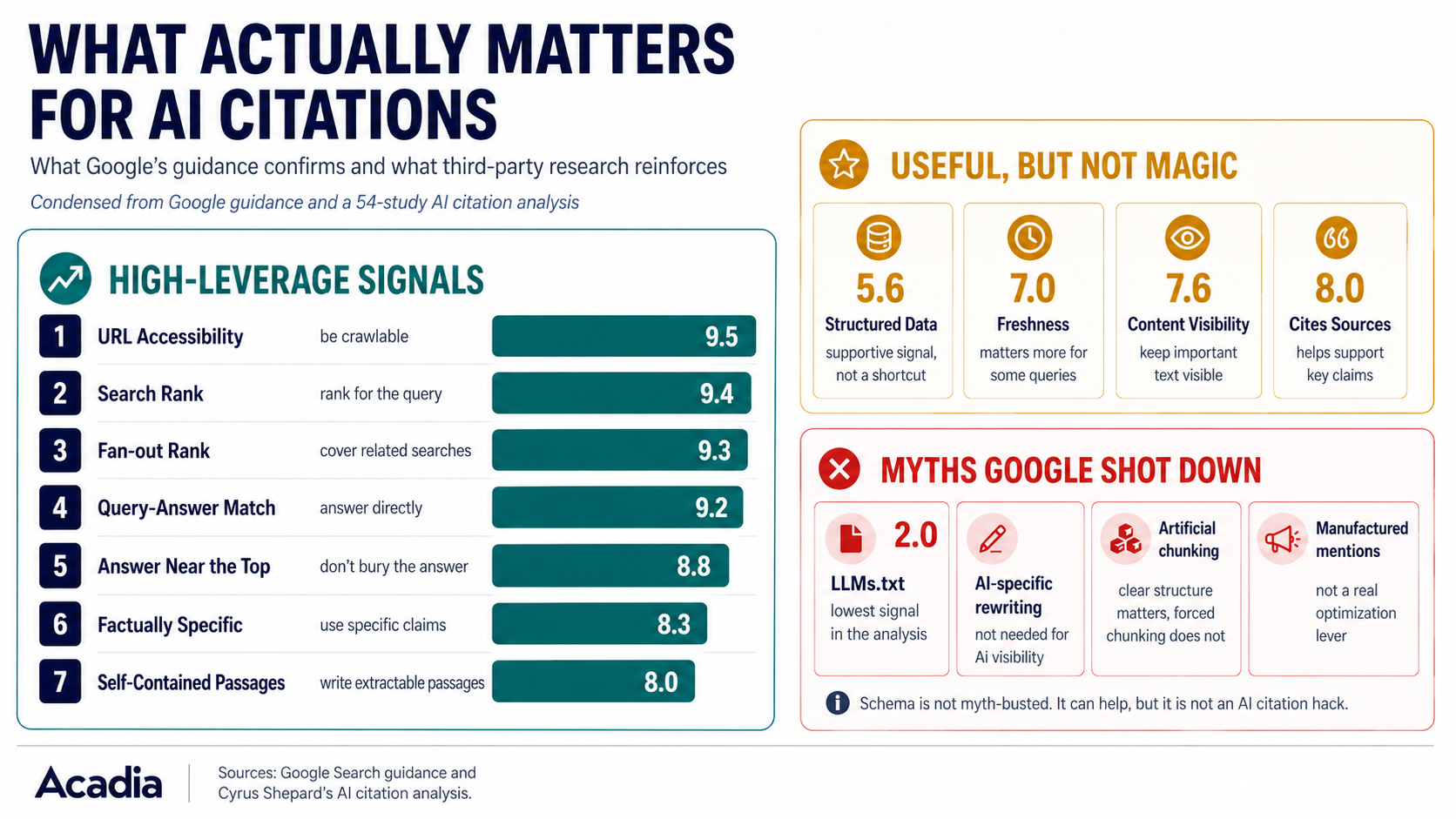
Source: Cyrus Shepard, “AI Citation Ranking Factors,” May 2026. Analysis of 54 experiments, patents, and case studies.
Each factor is scored by how often similar findings repeat across studies, how much weight the underlying evidence carries, and whether official documentation supports it.
The top six signals all score 9.0 or above: URL accessibility, Search rank, fan-out rank, preview controls, query-answer match, and intent-format match. Foundational SEO applied to AI retrieval. The research confirms what Google said.
The tier below is where most sites are leaving citations on the table.
Answer placement (8.8). AI systems don't retrieve your entire page. Research by Dan Petrovic shows Google's Gemini applies a strict retrieval cap per URL. Content near the top makes the cut. Content below a long introduction may not be retrieved regardless of how well the page ranks.
Factual specificity (8.3). AI citations support specific claims in the answer. "Adults need a lot of protein" doesn't give a model something to cite. "Experts recommend 0.8 grams per kilogram of body weight" does. The more citable the claim, the more often it gets cited.
Explicit phrasing (8.1). Hedged statements don't produce confident AI summaries. "Some people prefer magnesium glycinate, while others use citrate or threonate" is a weaker signal than "Magnesium glycinate is the best choice for sleep." Definitive language outperforms qualified language.
Self-contained passages (8.0). AI retrieval is non-linear. A passage that requires surrounding context to make sense is a passage that won't survive extraction. Key claims need to stand alone, fully expressed within a sentence or short block.
These aren't technical requirements. They're editorial decisions. No link budget or trying to figure out Reddit required.
Why This Matters for Challenger Brands
The top-tier signals favor incumbents. Search rank, fan-out rank, domain authority, known source status compound over time and are hard to close quickly on raw scale. The mid-tier signals don't work that way.
A content audit framed around answer placement, factual specificity, explicit phrasing, and self-contained passages finds specific, actionable changes. The incumbent with fifteen years of domain authority is often coasting on it. The "ultimate guide" that tries to cover twelve subtopics produces the least reliable citation results. It gets retrieved inconsistently.
The page that answers a specific question with a focused heading and a citable claim near the top outperforms it.
That's something you can earn without outspending anyone.
I've argued before that AI role framing and brand recognition determine who gets chosen once you're in the consideration set. Research on AI Mode behavior shows that 37% of trust came from how the AI described the brand, more than multi-source convergence, more than review scores. The source material for that framing comes from somewhere. Brands with specific attributes, concrete trade-offs, and named claims show up with more confident AI descriptions. Brands that describe themselves generically produce generic summaries.
Clarity drives framing. Framing drives selection.
If you want to see where your brand sits in the consideration set and where the specific leverage is, reach out to our team.
Read more from this author: