
 Scott Walldren is the Head of SEO at Acadia.
Most brands looking at AI visibility dashboards are asking the wrong question.
They want to know: Are we showing up?
The more important question is: Are we the default example?
Known. Not chosen. There's a difference. And in AI-mediated discovery, that difference determines who gets shortlisted before a human ever clicks.
AI systems don't randomly assemble brand names when they generate answers to category questions. They reach for brands that represent clear, repeatable roles. When a model needs an example of "budget grocery," or "premium organic," or "bulk value for families," specific brands surface. Not because they ranked for a keyword, but because the association between that brand and that idea has been repeated so many times across so many sources that the system treats it as settled fact.
Those brands aren't just known. They're the default.
The brands that show up later in the list, or inconsistently, or only when the question is constrained by geography, are often well understood. They're accurately described. Their entity information is clean. Ask about them directly, and the AI gets it right. But ask a category question, and they disappear or get demoted to the "also consider" section.
That's not a visibility problem. It's not a sentiment problem. It's not even a content problem.
It's an archetype problem.
In AI-mediated discovery, brand strategy is no longer just about differentiation. It's about becoming the default reference point.
How AI Recommendation Actually Works
If you zoom in on how large language models actually work, this behavior isn't mystical. It's mathematical. LLMs learn statistical priors from massive volumes of text.
When a brand is consistently paired with the same descriptors across the open web, those pairings form strong frequency-weighted associations. Over time, that pairing becomes statistically dominant in the model's probability patterns. When a user prompt triggers a category concept, the brand most consistently paired with that role becomes the easiest example for the model to produce.
Repetition compounds. The most consistent brand-role pairing becomes the default shortcut.
That shortcut is what I mean by archetype. Not Jungian psychology. Not brand personality exercises. Just the compressed, repeatable idea a system reaches for when it needs an example of a category.
Why Signal Consistency Alone Isn't Enough
Earlier this year, I wrote about how AI systems surface signal inconsistency faster than traditional search ever did. When your press releases say one thing, your LinkedIn bios say another, and your partner pages reflect positioning from two rebrands ago, AI systems hedge. They produce generic descriptions. Fixing that fragmentation is real work, and it matters.
But consistency alone doesn't create default status.
A brand can be perfectly aligned across every owned surface, same language everywhere, clean entity data, no contradictions, and still fail to own a role. They're accurately described. They appear in comparison lists. They win on product-level discovery. But in broad category prompts, they show up late, or as an alternative, or not at all.
That's the gap between being known and being chosen.
Why the Middle Gets Skipped in AI-Generated Results
The pattern that keeps surfacing when you actually audit brands against AI outputs is that the middle gets skipped.
Premium wins. Cheap wins. Specialists win.
Brands with a single, tight identity show up first. Brands that occupy a reasonable middle ground, quality above conventional, price below premium, and broad enough to serve most shoppers, get framed as secondary options. Not because the AI has anything against them. But because "reasonable middle ground" isn't an archetype. There's no shortcut for it. When the model needs an example, it reaches for the poles.
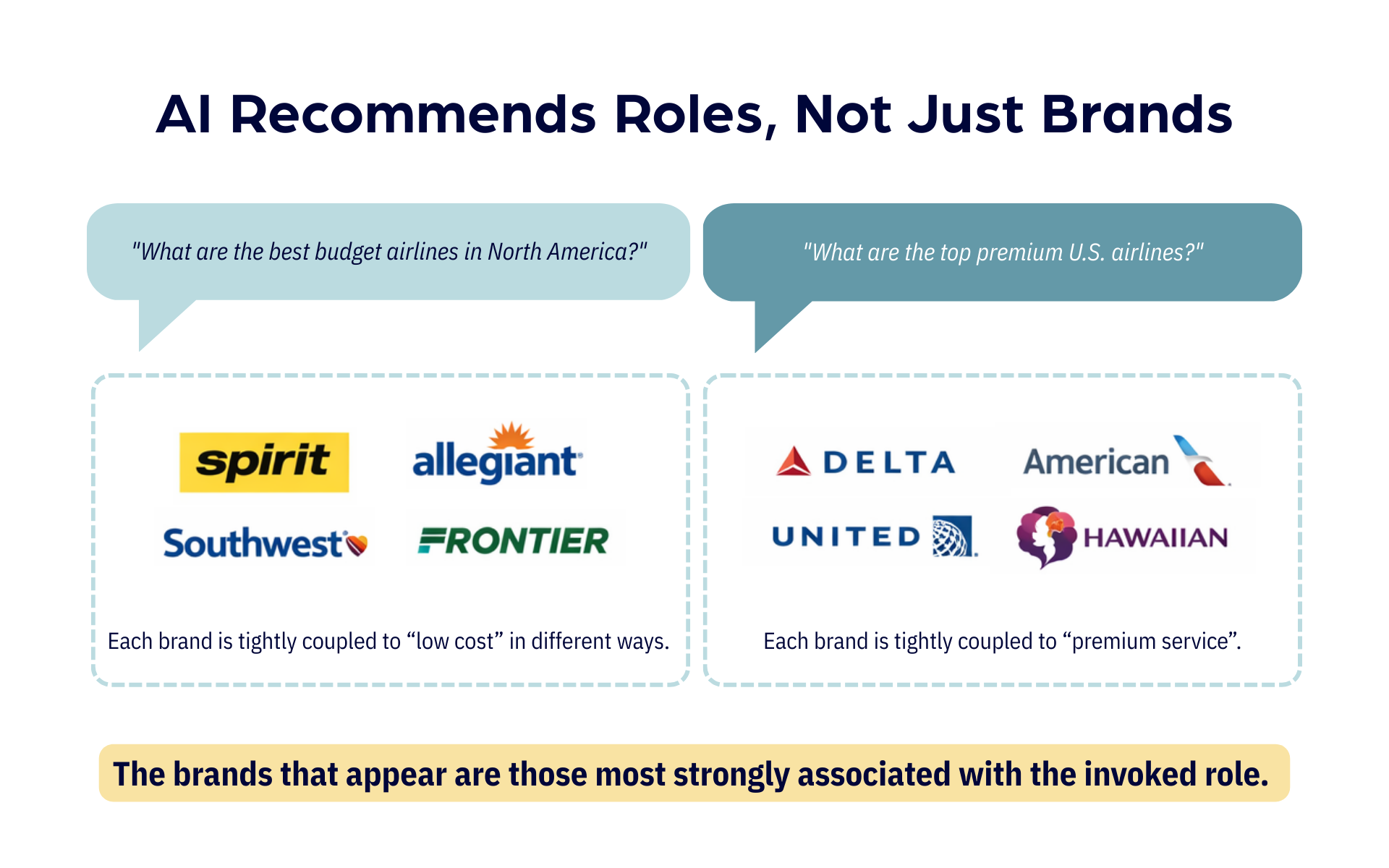
This is uncomfortable for brands that built their positioning around being the smart alternative to the extremes. That positioning makes complete sense to a human shopper who's tired of paying premium prices but doesn't want to sacrifice quality. "Smart alternative" is persuasive positioning. It's not a compressed identity. The middle is defensible positioning. It is not a dominant role. And persuasive is not the same as retrievable.
The first names in an AI-generated list are framed as dominant forces. The latter names are framed as regional picks, niche alternatives, or worth considering if. The difference isn't sentiment. It's archetype strength.
How Brands Build Archetype Ownership in AI Systems
Owning an archetype isn't achieved through isolated brand exercises. A tagline can reinforce an archetype. Brand personality can amplify it. But only if both compress around a single repeatable idea and stay there.
Southwest's "low fare airline" worked because it wasn't creative expression. It was enforced repetition. Barnum and Bailey's "Greatest Show on Earth" wasn't just a slogan. It was language discipline. Penn Jillette once noted they trained employees to use the full phrase in every interview, every time. The repetition was the point.
Taglines are tools. Archetypes are outcomes. The difference between brands that own a role and brands that don't is rarely the quality of the creative. It's whether the language was disciplined enough, repeated enough, and consistent enough across enough surfaces that the association became automatic.
A brand with archetype ownership has tight phrase coupling between its name and a core attribute. The same pairing shows up across owned signals, local signals, and open web signals. Third parties, editorial coverage, review platforms, and community discussions mirror the same language back. The brand appears in category-defining conversations, not just entity-specific ones.
When probability mass spreads across multiple partially overlapping ideas, the brand may appear in answers but rarely leads them. Archetype ownership concentrates that probability. It makes the system's job easier. And systems, like people, default to what requires the least cognitive work to retrieve.
What AI Visibility Actually Requires
Most brands are still optimizing for volume. More content, more campaigns, more announcements, more features to explain. What they're missing is that none of that volume matters if the signals that already exist don't align around a single retrievable idea.
The brands that win in AI-mediated discovery aren't producing the most content or running the most campaigns. They're the ones where every signal layer is pushing the same compressed idea. The website says it. The local listings say it. The press coverage says it. The community discussions say it. Not in identical words, but with enough consistency that the system treats the association as reliable.
The question isn't whether AI systems understand your brand. Most of the time, they do. The question is whether your brand has made it easy enough for a system or a prospect to know immediately what role you play.
Known is not enough.
Chosen is the goal.
If you're not sure which archetype your brand owns, look at the first three names AI generates when your category is mentioned without you in the prompt. That's your competitive archetype landscape. Where you sit relative to those names tells you more about your AI visibility problem than any dashboard will.
If you want to talk through what an AI visibility audit looks like for your brand or category, reach out to our team.
Read more from this author: