
 About the Authors: Ross Walker is the Retail Media Team Lead at Acadia. | Damiano Ciarrocchi is a Senior Retail Media Manager at Acadia.
- - -
Retail media has surged, with more than 200 networks now live, the opportunity for brands is massive, but so is the complexity, making media mix modeling services essential for marketers who need to explain channel allocation decisions to leadership.
The mistake many make is approaching each retailer in a vacuum.
But the reality is clear: your shoppers aren’t loyal to one retailer; they’re retail-agnostic.
They move seamlessly from Amazon to Walmart, from Instacart to Target, and often from online to in-store in the same purchase journey. That’s because they don’t think in terms of platforms. They think in terms of brands.
That means your strategy can’t live in silos either. To win in this environment, brands need to adopt a new omnichannel view: aligning creative, assortment, and investment to tell a consistent story wherever the shopper chooses to buy.
The solution starts with understanding how retail media got here, why platforms differ so widely, and how to connect creative, metrics, assortment, and budget allocation into one coherent retail media management strategy.
Let’s dive in.
How We Got Here: From Hopes to Reality
When retail media first took off, the assumption was that every major retailer would eventually resemble Amazon. The expectation was a full-funnel suite of advertising products, rich shopper data, and the ability to scale quickly across channels.
That hasn’t happened.
Some retailers built capabilities in-house; others outsourced parts or all of their networks to third-party providers. But many underestimated the difficulty of setting up a sophisticated ad platform.
Traditional retailers excelled in supply chain, store operations, and merchandising. But unlike Amazon, they hadn’t spent 15 years refining digital ad tech and data infrastructure.
It’s no coincidence that the most advanced networks belong to retailers with the largest, richest customer datasets. Smaller players with less scale have struggled to match that sophistication.
As a result, today’s retail media landscape is fragmented: not every retailer offers the same depth of targeting, measurement, or funnel coverage.
For brands, this means two things:
1) Not every retailer is the right fit for every marketing goal
2) A single “Amazon playbook” won’t translate across the rest of the retail media world.
Platform Differentiation: Not All Retailers Are Created Equal
Think marketing funnel for the customer journey:
- Awareness: Reaching people with little or no knowledge of your brand.
- Consideration: Building familiarity and interest.
- Purchase: Driving conversions.
- Loyalty: Encouraging repeat sales.

Amazon is the most mature across all funnel stages, with extensive tools for awareness, consideration, and conversion.
Walmart is catching up quickly, often delivering lower CPMs and CPCs that make it highly effective for awareness campaigns.
Instacart, while smaller, offers powerful incrementality: high returns for each additional dollar invested, particularly in grocery and convenience categories.
Target is earlier in its development, but in certain verticals, such as beauty or household goods, it can deliver strong incremental growth.
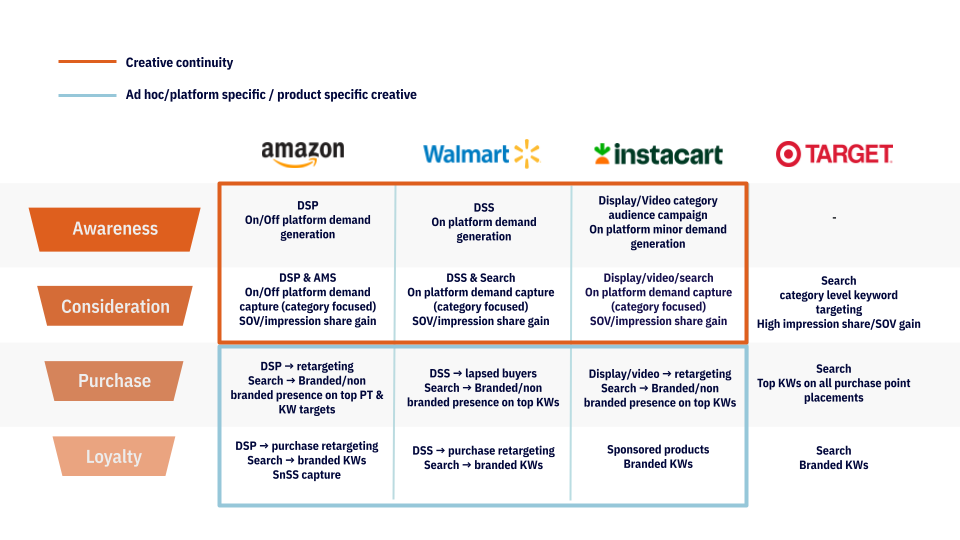
But, consumers themselves are retail-agnostic.
You don’t get to control how the consumer buys. Ads may be placed in front of them, but they might still choose to pick up in-store because it’s the most convenient option. Some brands focus on online sales and worry that they’re underperforming, without realizing that physical store sales are growing strongly as a result of the same campaigns.
A shopper might see an ad on Amazon, compare products on Target, and make the final purchase at Walmart. This also makes creative continuity vital.
At the top of the funnel, messaging should remain consistent across platforms to educate and inspire. At the bottom, ads can become more product-specific and retailer-tailored to drive conversion and loyalty.
Metrics Matter
So, how can you evaluate retail media platforms?
The starting point is a structured, top-down analysis of each retailer: Which drives the most sales? Which generates the greatest demand for the product? Which offers a competitive advantage?
Once the broader landscape is clear, the next step is evaluating media-specific metrics.
Core metrics like CPC, CPM, impressions, and search performance remain essential. Even a simple side-by-side mapping of these metrics can reveal where opportunities lie.
One important aspect to keep in mind: not all metrics are calculated the same way, and those differences can dramatically affect interpretation.
Consider “new-to-brand” customers, for example:
- Amazon and Walmart use a 12-month lookback.
- Instacart uses just six months.
That means the same number on two dashboards can reflect very different realities. So before making the comparison, make sure your teams are educated on these differences.
Example:
Let’s take a look at a concrete example from one of our clients. In this case, aligning KPIs across networks as closely as possible allowed meaningful trends to emerge:
Walmart: Efficient Awareness Building
- CPM and CPC were consistently lower than other networks.
- Walmart was highly effective in maximizing reach and generating awareness within a set budget.
Amazon: Strong New-to-Brand Growth
- High new-to-brand rates and strong incremental ROAS.
- Amazon excelled at new customer acquisition and driving final conversions, making it a valuable channel for product launches.
Instacart: High Incremental Returns
- Incremental investment delivered ~4.2x incremental ROAS, despite a smaller scale.
- Instacart proved to be an efficient place for deploying additional advertising dollars.
Target: Emerging Potential
- As a newly launched channel, early results were weaker (“red across the board”).
- Including Target in the comparison provided a baseline for tracking growth and understanding future opportunities.
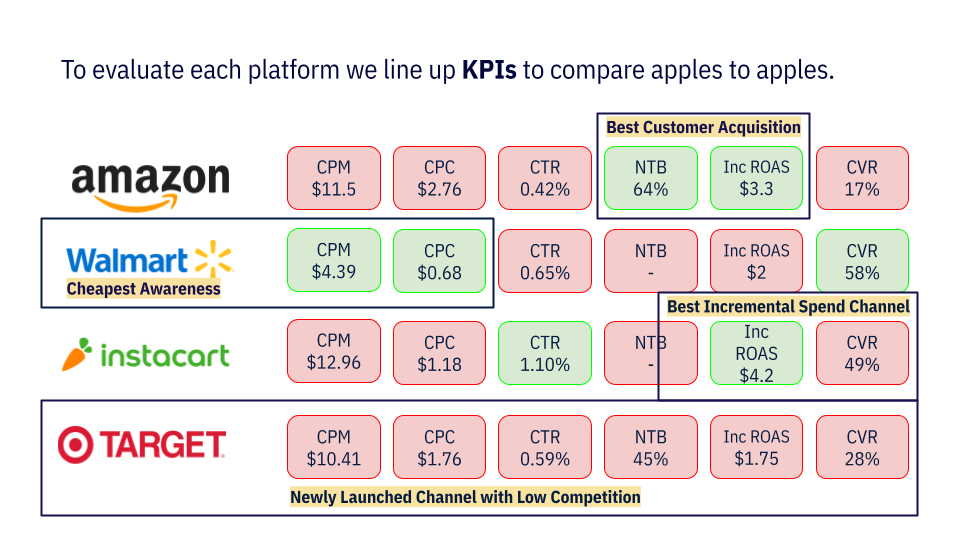
Providing this kind of “apples-to-apples” comparison across platforms helps leadership understand the unique value of each network. It shifts the conversation from chasing a single KPI, like ROAS, to weighing both capabilities and performance together.
By educating teams on how metrics are defined and by presenting side-by-side comparisons that reflect platform nuances, brands can justify continued investment across multiple retailers.
The goal isn’t to declare one “winner,” but to allocate spend where each dollar works hardest in service of the broader omnichannel strategy.
Smarter Media Allocation: Where to Place Your Bets
Once you understand platform capabilities, metrics, and performance, the next critical question is: where should you allocate your media budget?
Many brands still default to simple allocation models that rely heavily on total ROAS or aggregate ACoS.
For example, a budget might be split like this:
- Amazon: $100,000, because a $1 million return is expected.
- Walmart: $50,000, proportional to the $500,000 generated in the past.
- Instacart: $30K because we want a total ROAS of 10
- Target: $20,000 to support a smaller channel.
This approach is straightforward, but also limiting. It treats every retailer as if they serve the same role in the funnel. It assumes last month’s sales are the best guide to next month’s budget. And it risks under-investing in platforms with unique strengths.
A more effective model incorporates the nuances of each network:
- Amazon gets $110K because we get the most NTB customers.
- Walmart gets $60K because we get the cheapest impressions and clicks for our awareness.
- Instacart gets $25K because highest incremental sales through spend injection.
- Target gets $5K because we can only focus on the lower funnel, and incremental spend has a low effect on total sales.
The point isn’t to dismiss ROAS or ACoS. Profitability metrics remain essential. But relying on them exclusively ignores the broader picture. By layering in platform-specific KPIs, shopper behavior, and funnel role, each next dollar can work harder.
A Heuristic for Platform Prioritization
When comparing retailers, two factors stand out: the diversity of tactics available and the incremental impact of investment.
- Amazon: The most effective place for your bets.
- Walmart: A close second, developing capabilities at the fastest pace and catching up to Amazon the quickest.
- Instacart: Introducing off-site placements + the ability to offer full-funnel tactics and also show incrementality.
- Long-tail retailers: Generally less impactful overall, though exceptions exist where category fit or brand following is especially strong.

Of course, these rules vary by category. In beauty or household essentials, Target may be the most strategic bet because its shoppers already align closely with the brand’s audience.
In grocery, Instacart may be disproportionately valuable. The goal isn’t to apply a rigid formula, but to compare networks side by side and decide where each additional dollar will deliver the greatest impact.
Assortment and Media: A Two-Way Street
Another important question is: Does assortment dictate media, or can media shape assortment?
In practice, it’s both, but assortment often leads. Unique SKUs, retailer exclusives, or differentiated pack sizes are natural candidates for focused media support.
These products avoid pricing conflicts and often perform well when positioned as “hero products.” At the same time, media can inform assortment. Performance data often reveals which SKUs resonate most, guiding innovation in flavors, sizes, or multipacks.
Retailers themselves attract different shopper mindsets: the bulk buyer at Costco, the convenience shopper at Instacart, the loyalty-driven shopper on DTC sites, and media insights can help brands tailor assortments accordingly.
The key is ensuring media and assortment work hand-in-hand, reinforcing one another rather than operating in silos.
The takeaway? Brands must focus on delivering a cohesive brand experience across all touchpoints. The goal is to ensure that wherever and however the shopper decides to buy, they encounter consistency in value, messaging, and brand identity.
The Omnichannel Flywheel
The most effective strategies view retail media as an interconnected ecosystem.
At Acadia, we use the “omnichannel flywheel” to deploy five main tactics:
- Placing bets on the right platforms and products.
- Capturing demand with strong search coverage and defensive plays.
- Generating demand with off-site media and creative continuity.
- Testing and learning across tactics and funnel stages.
- Measuring success in incremental sales, not just ROAS.
Upper-funnel spend on Amazon may drive conversions on Walmart. A conquesting strategy on Walmart may increase Share of Voice on Target.
By ensuring brand messaging is consistent across touchpoints, the flywheel creates momentum that grows the pie across retailers.
📧 Get in touch to learn more about how we deploy the Omnichannel Flywheel for our clients.
The Future of Measurement: MMM Evolved
One of the most difficult challenges in omnichannel allocation is the lack of visibility across retailers. Media investments on Amazon may influence Walmart or Target sales, but networks don’t share data.
That’s where media mix modeling comes in. MMM isn’t new, but it’s evolving to meet the complexity of retail media.
Historically, MMM answered simple channel questions: how much TV vs. search vs. display.
Today, it must account for finer strategic levers:
- Should budget go to conquesting keywords on Walmart or generic terms on Amazon?
- Does awareness spend on Amazon drive sales velocity across Target?
- Are non-branded keyword efforts at Target truly incremental, or purely defensive?
MMM is unlikely to deliver perfect answers, but it can provide directional insight, highlighting correlations that guide better cross-retailer decisions.
For example, MMM might reveal that upper-funnel awareness spend on Amazon correlates with a lift in Walmart conversions two weeks later. That doesn’t give an exact formula for reallocation, but it arms marketers with confidence that Amazon awareness can fuel Walmart sales.
As retail media matures, MMM will become increasingly central to omnichannel allocation.
Conclusion
Winning in retail media means thinking the way shoppers do.
It means building an omnichannel flywheel where investments on one platform fuel growth on another. It means aligning assortment and media, balancing profitability with incrementality, and measuring success in terms of incremental growth, not just ROAS.
The retail-agnostic shopper is already moving seamlessly between Amazon, Walmart, Instacart, Target, and beyond. Your strategy should meet them where they are.
Not sure where you should place your bets?
Our team helps brands cut through the noise and turn fragmented retail media investments into a cohesive omnichannel growth engine.
Read more from this author: