Amazon’s Prime Big Deal Days 2026 delivered 32% year-over-year sales growth among comparable US Seller Central brands tracked by Acadia, with Beauty & Personal Care up 72%, Clothing, Shoes & Jewelry up 63%, and Grocery & Gourmet Food up 60%. Across the 16 category groups tracked, 13 recorded year-over-year growth, while event sales reached 3.5x normal daily levels, up from 3.2x in 2025.
The two-day event, held October 6 and 7, was notable in that demand remained strong throughout the sale, rather than tapering off after the first day. Beauty and consumables were among the biggest winners, while seasonal products saw significant sales spikes as shoppers began preparing for the holidays.
For brands, the biggest takeaway was that success during Prime Big Deal Days depended on more than discounting. Those that went into the sales days with momentum, focused on promoting a broad assortment of products, and secured top deal placements were in the best position to capitalize on the sales event.
Advertising performance added another layer of complexity. With CPCs rising 15% and ROAS falling the same amount, brands faced greater pressure to make their media investments work harder, prioritizing high-performing search placements and coordinated full-funnel campaigns. Acadia’s POV is that scale comes from leaning into the niches that are most likely to provide incremental value and that often means lower ROAS, especially for the new brands we bring on. With an average 32% growth year over year that strategy has proven incredibly successful.
To unpack the results, Acadia’s retail media team analyzed sales data, promotional strategies, category performance, and platform changes across the brands we manage. Here’s what we found, and what it means for the all-important holiday shopping season right around the corner.
Why Prime Big Deal Days 2026 Looked Different
One of the biggest changes this year was how Amazon puts deals in front of shoppers.
The red Prime Big Deal badge was more prominent across search results and product pages, while the actual percentage discount was less visible. In many cases, shoppers saw a red badge with a product’s typical price crossed out, but how much they were saving wasn’t clear.
This created an interesting dynamic for brands. Securing a deal badge was increasingly important for visibility, but offering a deeper discount didn’t necessarily make a product stand out more if shoppers couldn’t immediately see the difference.
At the same time, search results became more crowded. Amazon increased Sponsored Brands and Sponsored Products placements, making it harder for products to maintain visibility through organic rank.
Amazon also introduced new features, including a text-based sponsored placement beneath the product carousel and a “crazy-good finds” module promoting Amazon Haul products alongside Prime deals.
The result was an event where promotional visibility became just as important as the offer itself.
Brand Participation and Customer Demand
Overall Performance
Prime Big Deal Days delivered another strong performance for brands.
Among comparable US Seller Central brands, event sales grew 32% year-over-year. More importantly, brands entered the event with stronger underlying sales and still generated a larger promotional lift than in the prior year.
Key findings:
- Event sales increased 32% year-over-year, with Day 1 up 32% and Day 2 up 33%.
- Day 1 accounted for 51% of event sales and Day 2 for 49%, compared with 52% and 48%, respectively, in 2025.
- Event sales reached 3.5x normal daily levels, up from 3.2x in the previous year's comparable tracking.
- 61% of brands grew year-over-year, while 23% more than doubled their event sales.
- One in five brands achieved at least 5x their normal daily sales, and 11% reached 10x or more.
The data also showed a relationship between pre-event performance and event success. Of brands whose daily sales were growing year-over-year before Prime Big Deal Days, 81% also grew during the event. Among brands entering the event with declining sales, only 23% managed to grow.
This proves a lesson from Prime events past: brands can’t rely on a two-day promotion to reverse weeks of weak performance. The work done in the lead up to build traffic and maintain customer engagement plays a major role in event results.
Day 2 Was Almost as Big as Day 1
Another notable development was the strength of the second day.
Day 2 delivered 95% of Day 1 sales, marking the most balanced two-day performance in Acadia’s tracking. Day 2 sales also grew slightly faster year-over-year than Day 1, suggesting that customer demand remained strong through the end of the event.
Amazon appeared to encourage that momentum through its visuals. On Day 2, the platform switched event banners from blue to bold red, creating a greater sense of urgency as the sale approached its conclusion. While we don’t know how much that drove more sales, the results make a strong case for keeping advertising budgets and inventory support in place through the full event.
Brands should also beware of evaluating Day 2 too quickly. Sales data continued arriving more than 24 hours after the event, with reported Day 2 sales increasing by approximately 16% a day later.
The Hypergrowth Playbook
While the overall results were strong, several brands significantly outperformed the average.
One brand grew sales by 615% year-over-year, while another generated 20x its normal daily sales during the event.
Among the 18 brands participating in their first Prime Big Deal Days with Acadia, sales averaged 4.4x normal daily levels. One-third achieved at least 5x their usual sales, and the strongest reached 20x.
Several categories produced particularly impressive individual results:
- An intimates brand grew sales 6x year-over-year.
- A jerky brand grew 5x.
- A skincare brand grew nearly 4x.
- An electrolyte brand and a leather goods brand each grew approximately 3x.
There was no single formula behind every standout result, but Acadia’s analysis revealed some things the brands had in common: strong pre-event momentum, multiple products on sale, and visible offers supported by effective merchandising.
Consumer Demand Trends: Beauty and Consumables Lead Growth
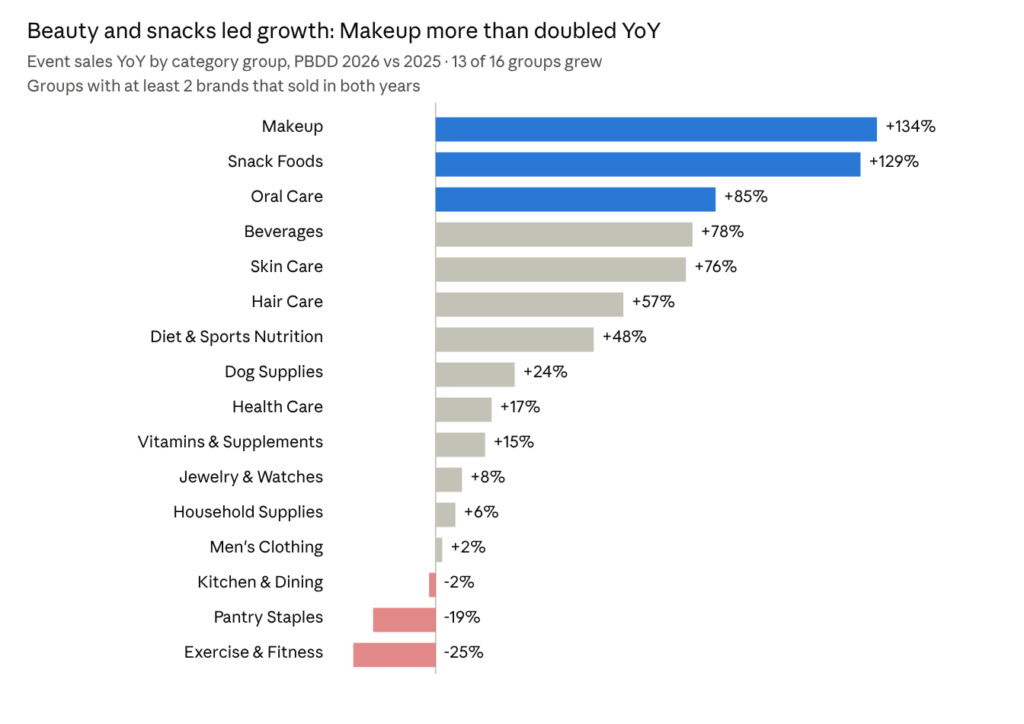
Beauty & Personal Care was the standout category of Prime Big Deal Days 2026, with sales growing 72% year-over-year. Makeup, Oral Care, and Skincare were among the fastest-growing product groups.
Apparel and consumables also performed well, while seasonal products generated some of the largest sales spikes relative to their normal daily volume.
Across Acadia’s tracked categories:
- Beauty & Personal Care: Sales increased 72% year-over-year, reaching 5.1x normal daily sales.
- Clothing, Shoes & Jewelry: Sales grew 63%, with a 3.2x event lift.
- Grocery & Gourmet Food: Sales increased 60%, with a 2.2x lift.
- Health & Household: Sales grew 37%, with a 3.4x lift.
- Pet Supplies: Sales increased 24%, with a 1.8x lift.
- Home & Kitchen: Sales grew 5%, with a 6.5x lift.
- Patio, Lawn & Garden: Sales increased 6%, with a 13.6x lift over normal daily sales.
- Sports & Outdoors: Sales declined 28% year-over-year, with a 1.8x lift.
While Beauty & Personal Care, Clothing, Shoes & Jewelry, and Grocery & Gourmet Food recorded the strongest year-over-year growth, these category-level figures don't necessarily reflect the performance of every brand within each group. To understand how broadly the gains were shared, we also need to consider individual brand performance and whether a small number of brands contributed disproportionately to the overall growth.
Overall, 13 of the 16 category groups tracked by Acadia experienced year-over-year growth.
The results point to two distinct shopping behaviors: first, consumers responded strongly to promotions on everyday products, particularly beauty, grocery, and household essentials. These categories delivered some of the strongest year-over-year gains.
Second, shoppers appeared to be getting an early start on seasonal and holiday purchases. Products such as fire pits, indoor gardens, and humidifiers generated sales spikes of 10-14x normal daily levels.
Not every category benefited equally. Home & Kitchen saw a smaller promotional lift than in 2025, declining from 7.6x to 6.5x normal daily sales despite modest year-over-year growth. Big-ticket kitchen products experienced a smaller spike.
Sports & Outdoors was the only major category in the reported results to decline, reflecting the challenges of promoting some outdoor and fitness products outside their peak seasonal windows.
For brands, these differences underscore the importance of tailoring promotional strategies to category demand, rather than assuming that every product will benefit equally from an Amazon sales event.
Promotional Strategies: What Worked and What Didn’t
One of the clearest findings from Prime Big Deal Days 2026 was the advantage of promoting a broader assortment of products.
Brands that discounted their full catalogs saw median year-over-year sales growth of 32%, compared with a 7% decline among brands promoting only selected products. 80% of brands running full-catalog promotions grew year-over-year, compared with 42% of those discounting only select products.
Prime Exclusive Discounts Remain a Key Tool
Prime Exclusive Discounts (PEDs) continued to play an important role in event performance.
Brands using PEDs saw median year-over-year growth of 32%, compared with an 11% decline among brands that did not use them. 71% of PED brands grew year-over-year, versus 38% of brands without PEDs.
Typical discounts ranged from 20 to 30% on bestsellers, broadly in line with the 25 to 30% discounts Acadia's team observed among competing products.
Coupons also performed strongly, with participating brands achieving median growth of 50% and a 3.6x lift over baseline.
By comparison, brands relying solely on sale pricing, without a PED, coupon, or promotional badge, saw median sales decline 18% year-over-year.
The difference reflects a broader shift in Amazon’s merchandising: offering a lower price isn’t enough if shoppers can’t easily identify the product as part of the event.
Advertising Performance: Higher Costs, More Competition
Advertising became more expensive during Prime Big Deal Days 2026, as brands competed for visibility across an increasingly crowded marketplace.
Acadia’s advertising data showed that cost per click increased 15% year-over-year, while return on ad spend declined 15%, despite a 1% increase in conversion rate.
This means that shoppers remained willing to purchase, but the cost of reaching them made advertising less efficient. With competition intensifying during major shopping events, brands need to be more strategic about where they invest their budgets and how they reach consumers throughout the purchase journey.
Sponsored Products Dominated, While Sponsored Brands Gained Ground
Sponsored Products remained the largest advertising investment for Acadia-managed brands, accounting for 87% of total spend.
However, Sponsored Brands gained share, with spending increasing 57% year-over-year to represent 11% of the total. The majority of that increase went toward product collection and store campaigns, which delivered the strongest ROAS within Sponsored Brands. Video spending remained relatively flat.
The shift reflects the growing importance of formats that help brands stand out beyond individual product listings and direct shoppers toward a broader assortment.
Competition for Sponsored Brands placements was particularly intense, especially for video. Brands that secured the top sponsored placement within their categories were able to capture outsized shopper interest and achieve strong click-through rates during the event.
Top-of-Search Placements Delivered the Strongest Returns
With search results increasingly crowded, brands concentrated their investments on the placements most likely to convert.
Top-of-search placements accounted for 46% of Acadia-managed advertising spend and delivered the highest ROAS and conversion rates among the tracked placement types.
Meanwhile, brands reduced their investment in detail page and rest-of-search placements, prioritizing visibility at the top of search results.
Off-Amazon placements were an interesting development. Spending on these placements increased nearly 800% year-over-year, although they still represented just 3% of total advertising spend.
Despite their relatively small share, off-Amazon placements generated surprisingly strong returns, suggesting that Amazon's advertising reach beyond its own marketplace is becoming more effective.
However, brands still have limited control over exactly where these ads appear and what content accompanies them. As a result, Acadia does not expect to intentionally scale investment in these placements significantly during future events, although their improving performance is worth monitoring.
Full-Funnel Strategies Helped Drive Growth
Some of the strongest-performing brands took a broader approach to advertising, combining visibility on Amazon with awareness-building campaigns across other channels.
A combination of Streaming TV and audio advertising to build awareness, followed by onsite and offsite retargeting, produced particularly strong results.
Acadia also used Amazon Marketing Cloud (AMC) audiences to make campaigns more targeted. By combining high placement modifiers with lower base bids, brands could prioritize specific audiences, including purchaser and subscriber lookalikes, customers who had purchased during previous tentpole events, and shoppers previously exposed to upper-funnel campaigns.
These strategies highlight the growing importance of connecting awareness, consideration, and conversion rather than treating Prime Big Deal Days as a purely lower-funnel sales event.
Platform Glitches and Operational Challenges
Despite strong sales performance, Prime Big Deal Days 2026 brought several platform changes and operational challenges that affected how brands managed their promotions.
Search and Deal Visibility Became More Competitive
Amazon’s increasingly crowded search environment was one of the biggest challenges observed by Acadia. More Sponsored Brands and Sponsored Products placements competed with organic results, while additional deal merchandising took up valuable space on search pages. This made paid coverage on priority keywords particularly important, even for brands with strong organic rankings.
Amazon also introduced a new clickable, text-based sponsored placement beneath the product carousel, creating another potential opportunity for brands to reach shoppers outside traditional ad formats.
Meanwhile, the introduction of an Amazon Haul “crazy-good finds” module alongside Prime deals brought ultra-low-priced products into the same browsing experience.
For brands, these changes suggest that search visibility will continue to require a combination of organic ranking, paid advertising, and promotional merchandising.
Deal Badging Wasn’t Always Consistent
Amazon’s promotional messaging also varied across listings.
Some products displayed a “30-day low price” callout beneath their deal badges, while others with similar pricing did not. Green badges and coupon-plus-deal combinations were less prominent than in previous events.
Subscribe & Save coupons were another point of friction. When a product had both a Prime Big Deal badge and a Subscribe & Save coupon, the coupon was not visible in search or on the product page until the shopper selected Subscribe & Save.
For brands focused on subscription growth, this created a potential trade-off between event visibility and communicating ongoing savings.
These inconsistencies reinforce the importance of checking how promotions actually appear to shoppers, rather than assuming that an approved offer will be displayed as expected.
Inventory and Merchandising Shifts
Inventory management remained a central consideration for brands participating in Prime Big Deal Days.
Many used the event to move excess or slow-selling inventory, including products with more than 40 days of supply, high weeks of cover, or discontinued items.
This approach can help free up space and improve inventory positioning ahead of the holiday season, but it also requires careful planning to avoid discounting products unnecessarily or running out of stock on strong sellers.
Inventory and budget constraints also influenced whether brands participated at all.
Two Acadia clients sat out the event because of budget cuts or inventory challenges. Of those, the brand with comparable prior-year sales experienced a 95% year-over-year decline during the event.
The results illustrate the potential cost of sitting out a major shopping event, particularly for brands that have historically relied on promotional periods to drive sales.
At the same time, participation should not come at the expense of profitability. Brands need to balance the benefits of increased sales volume with margin protection, inventory availability, and the ability to support demand through the remainder of Q4.
The Road to Black Friday and Cyber Monday
Prime Big Deal Days is over, but the insights from the event offer a roadmap for Black Friday and Cyber Monday.
The brands that performed best entered the event with momentum, offered visible promotions across a broad assortment, and maintained support throughout both days.
With the holiday shopping season approaching, here are the priorities brands should focus on.
- Build Momentum Before the Event
Brands with growing sales ahead of Prime Big Deal Days were far more likely to grow during the event itself. That makes the weeks leading up to Black Friday critical for improving product rankings, building reviews, maintaining traffic, and ensuring listings are ready to convert. The goal is to enter the event with existing demand, rather than relying on discounts to generate it from scratch.
- Broaden Promotional Participation
Full-catalog promotions outperformed narrower strategies in Acadia’s tracked sample. While discounting every product may not make sense for every brand, expanding the number of eligible products can create more opportunities for visibility and conversion. Brands should evaluate which products can participate profitably while ensuring that their bestsellers are supported.
- Prioritize Visible Offers Over Plain Sale Pricing
PEDs, Best Deal badges, and coupons were associated with stronger performance than sale-price-only promotions. With Amazon emphasizing badges in search results, brands should secure promotional eligibility early and avoid relying solely on strikethrough pricing.
- Protect Margins When Setting Discounts
More aggressive discounts don’t automatically translate into better visibility. When Amazon hides the percentage saved, the incremental value of a deeper discount may be limited. Brands should benchmark their pricing against direct competitors and evaluate the margin impact of additional discounting.
- Plan for Both Days
Day 2 delivered 95% of Day 1 sales, making it clear that brands should not concentrate all their resources on the opening day. Maintain sufficient inventory, advertising budgets, and operational support through the full promotional window.
- Stay Ahead of Amazon’s Changes
From automatically generated deal pages to inconsistent coupon visibility, Amazon continues to adjust how promotions appear to shoppers. Brands should monitor listings, deal badges, product content, and search placements throughout the event, with teams ready to respond when something changes.
- Make Advertising Budgets Work Harder
With CPCs rising and competition intensifying, brands should prioritize the placements and audiences most likely to deliver returns. Top-of-search placements performed particularly well during these deal days, while brands that combined non-branded search visibility with offsite awareness and retargeting saw strong results.
For Black Friday, consider how Amazon DSP, AMC audiences, and upper-funnel media can work together to build demand before the event and convert shoppers once promotions begin.
- Turn Event Traffic Into Q4 Customers
The period following Prime Big Deal Days offers an opportunity to re-engage shoppers who showed interest but did not convert. Among Acadia's tracked brands, common lead-out strategies included Brand Tailored Promotions targeting cart abandoners and evergreen Subscribe & Save coupons. These tactics can help keep brands visible without extending broad public discounts, while supporting retention and repeat purchases ahead of the holiday shopping peak.
Closing Thoughts
Prime Big Deal Days 2026 reinforced an important shift in Amazon’s promotional environment: participation alone is no longer enough to stand out.
As search becomes more crowded and promotional badges take on greater importance, brands need to be more strategic about how they combine pricing, product visibility, inventory, and advertising.
The strongest results came from brands that were already growing before the event, made their offers easy to discover, and maintained momentum across both days.
With Black Friday and Cyber Monday approaching, those lessons will become even more important. The opportunity isn't simply to drive a bigger sales spike, but to turn the demand generated by tentpole events into sustainable growth throughout Q4.
Read more from this author: