✍️ Scott Walldren is the Head of SEO at Acadia.
Earlier this year, I argued that AI systems don't surface brands for being good. They surface brands for being obvious. That piece was a theoretical argument about how language models retrieve information. It made sense if you accepted the underlying logic about probability and repetition.
Six weeks later, the data showed up.
Kevin Indig published a usability study with Citation Labs and Clickstream Solutions tracking 48 participants through 185 high-stakes purchase tasks across televisions, laptops, washer/dryer sets, and car insurance.
AirOps analyzed 16,851 queries through ChatGPT's full retrieval pipeline. ChatGPT cut the number of domains it cites per response by 20% after switching to GPT-5.3. Google's March core update demoted intermediaries and rewarded destinations.
Concentration is real and accelerating.
This is where most analysis stops, with a verdict that sounds like "become the category default or lose." That framing is wrong for the brands I work with. Acadia's clients aren't fighting Nike for share of "athletic shoes." They're the smart challenger inside categories where the archetype is already taken. The work is to earn a place in the consideration set as that set gets smaller.
There's more room there than the headlines suggest, but less than there used to be.
What The Study Actually Found
Three findings from the AI Mode study matter for challenger brands.
First, 88% of users took the AI's shortlist outright. Across laptop and insurance tasks, only 8 of 147 codeable AI Mode tasks produced a genuinely self-built shortlist. In classic search, 56% of participants built their own shortlist from multiple sources. The comparison phase didn't shrink in AI Mode. For most participants, it didn't happen.
Second, the item ranked first in the AI's response became the final pick 74% of the time. Mean rank of the final choice was 1.35. Only 10% chose something ranked third or lower.
Third, the 26% who overrode rank order didn't reject the AI. 81% of them still chose from within the AI's candidate set. They just preferred a more familiar brand lower in the list.
That third finding is the one challenger brands should sit with. Brand recognition can override rank, but only if you're already in the candidate set. The brands not surfaced by the AI were never considered. The brands surfaced without recognition got eliminated on name alone. One participant dropped Erie Insurance because it lacked a hyperlink in the AI output, reading the formatting gap as a credibility signal.
The frame that matters isn't "be the top recommendation or lose." It's "be in the list with enough recognition to survive selection."
Domain Authority Is Not The Moat
The AirOps study analyzed which pages ChatGPT actually cites and found that domain authority shows no positive correlation with citation. Pages from lower-DA domains get cited at the same rate as pages from high-DA domains. Sometimes more often. The five highest-DA site types they tracked produced citation rates ranging from 2.4% (YouTube) to 59% (Wikipedia). Nearly identical authority, wildly different outcomes.
For two decades, SEO treated DA as a stand-in for trust. It was the proxy incumbents used to compound. The number on the dashboard that told you whether you were ahead or behind. AI citation pipelines don't weight it the same way. They reward retrievability, which is a function of how cleanly a page maps to a query, how directly the heading answers the question, and how focused the page is on a specific role.
The AirOps data also flagged something useful. Pages cited inconsistently (some of the time but not always) had the longest content, the most headings, and the highest DA. They're the "ultimate guides" that try to cover everything. AirOps frames this as the "cover everything, earn links, hope to be cited" strategy, and the data shows it produces the least reliable results.
A challenger brand cannot out-link an incumbent that's been around for fifteen years. It can out-clarify them. The page that answers a specific question with a focused heading beats the ultimate guide that hedges across twelve subtopics.
How The AI Describes You Matters As Much As Whether It Appears
The Indig study found that AI framing (37%) and brand recognition (34%) were the top two trust drivers in AI Mode. Multi-source convergence, the dominant trust mechanism in classic search, dropped to 5%.
When users don't have a prior view of a brand, they treat the AI's description as if the cross-checking has already been done for them. The synthesis becomes the corroboration.
That puts a different kind of pressure on the source material. Brands described with specific attributes (named price, specific use case, concrete trade-off) held stronger positions than brands described generically. One participant on insurance said it directly: "Travelers and USAA actually tell me how much, whereas State Farm and GEICO give percentages. Just knowing the exact amount makes me want to pick Travelers or USAA right off the bat."
The AI's formatting drove the decision. Dollar amounts beat percentage discounts. Brands giving the AI clearer material to work with showed up with more confident framing.
Where Is There Leverage?
Challenger brands have plays that don't require the budgets archetype brands have.
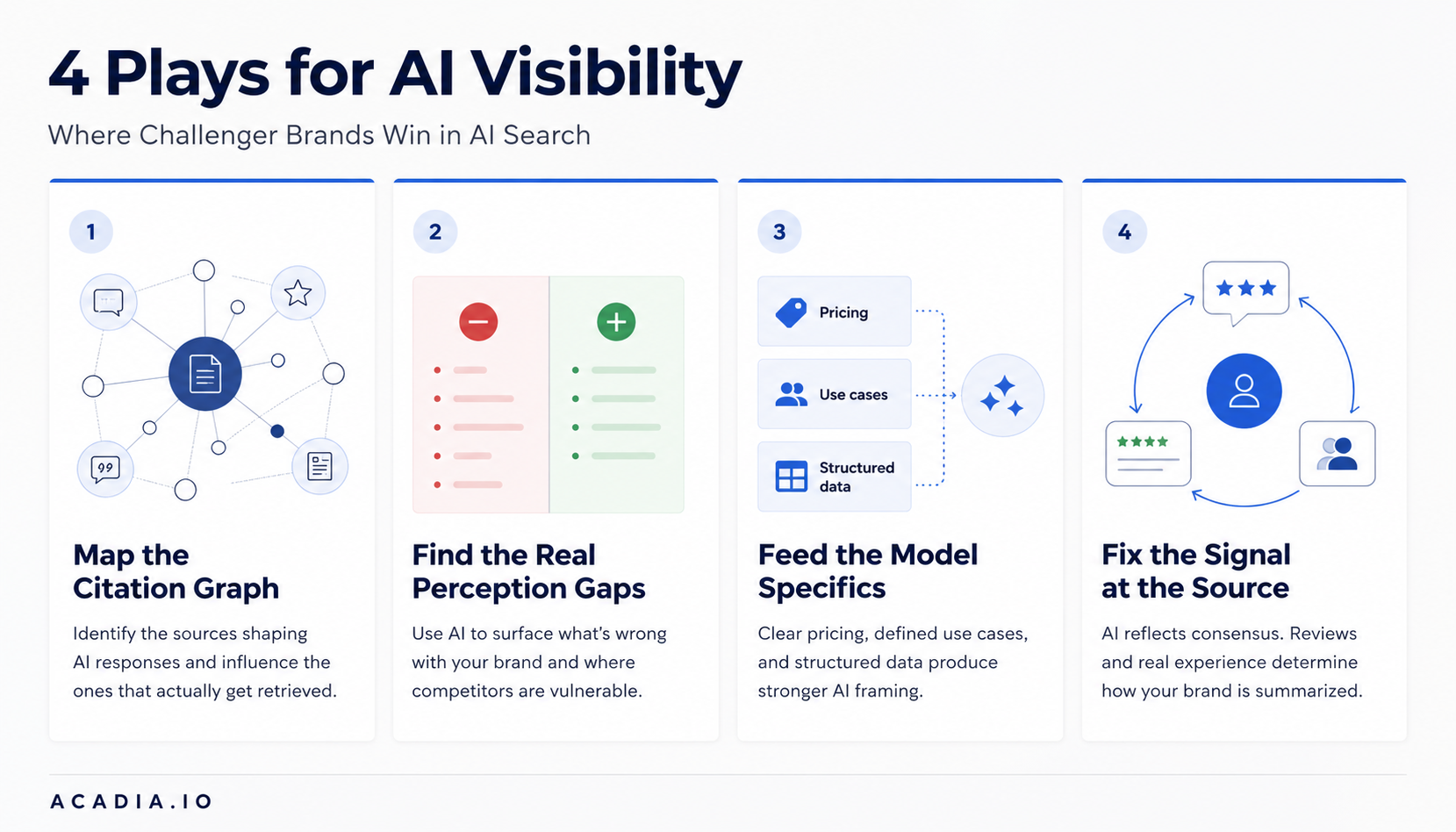
- Map the citation graph. AI systems don't pull from your website alone. They pull from review sites, forums, editorial coverage, and platforms that host opinion and discussion. We did a version of this for a client recently when their reputation was being shaped by an active legal dispute. We pulled the prompts buyers might be asking, identified which third-party sources were informing AI responses, and the client used existing PR relationships to influence those specific sources. The leverage was in knowing which sources were doing the talking and actively being retrieved across platforms and traditional search.
- Run negative prompt analysis. Ask AI tools what's wrong with your brand and what's wrong with your category. The patterns that come back tell you where your perception problem actually sits and where the incumbent is structurally vulnerable. The middle gets generic when challenger brands try to be a softer version of the leader. It gets specific when challenger brands name the thing the leader doesn't solve.
- Give the AI better material. Specific pricing, named use cases, concrete trade-offs, structured product data. The brands that showed up with confident framing in the Indig study did it because the underlying source material was specific. Vague descriptions produce vague AI summaries.
- Fix the product. AI systems summarize consensus. Reviews, sentiment, and customer experience travel through the citation graph faster than they used to. Marketing can amplify a brand that delivers. It cannot manufacture the signal of a brand that disappoints.
What We Do At Acadia
This is the work we do for mid-market and enterprise clients trying to earn AI visibility without competing on raw scale. We map the prompt landscape for your category, audit which sources are shaping AI responses about your brand, and identify the gaps between how you describe yourself and how the citation graph describes you. The deliverable isn't a dashboard. It's a list of specific moves your team can run with the relationships and assets you already have.
The brands winning here aren't producing more content or chasing more platforms. They're being more specific about what they stand for and more disciplined about reinforcing it across the surfaces that AI systems actually pull from.
Concentration favors clarity. Clarity is something you can earn.
If you want to see what your AI visibility actually looks like and where the leverage is for your brand, reach out to our team.
Read more from this author: